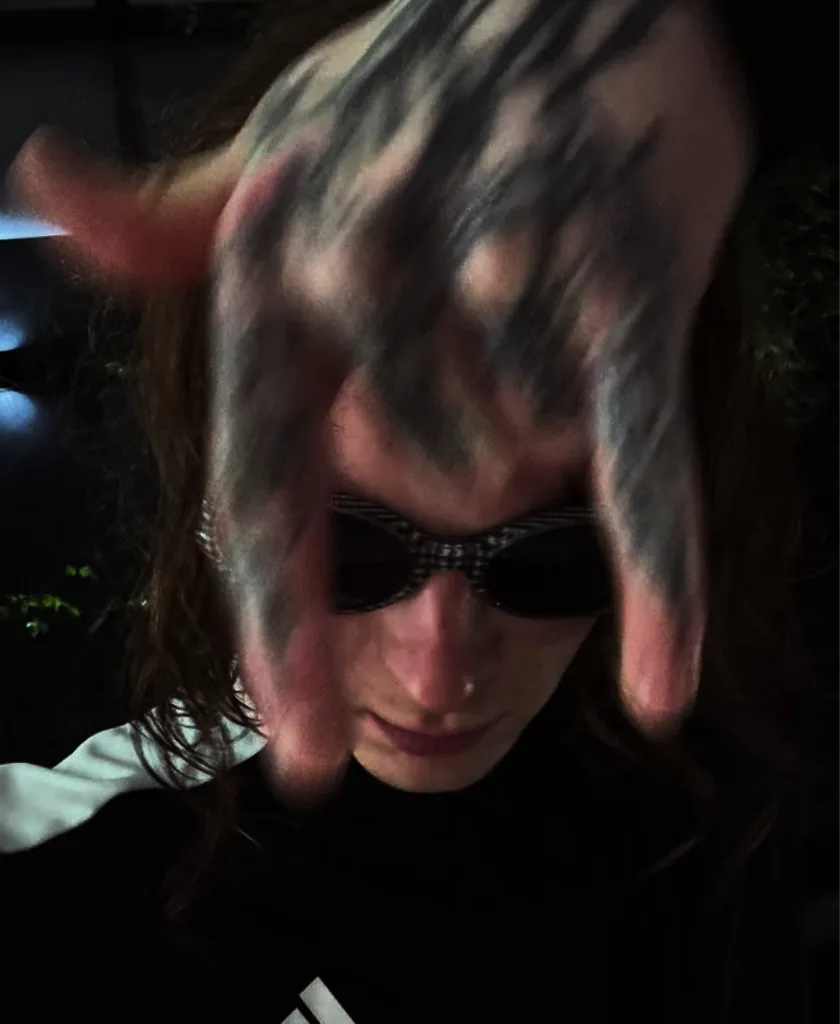

srnkdev

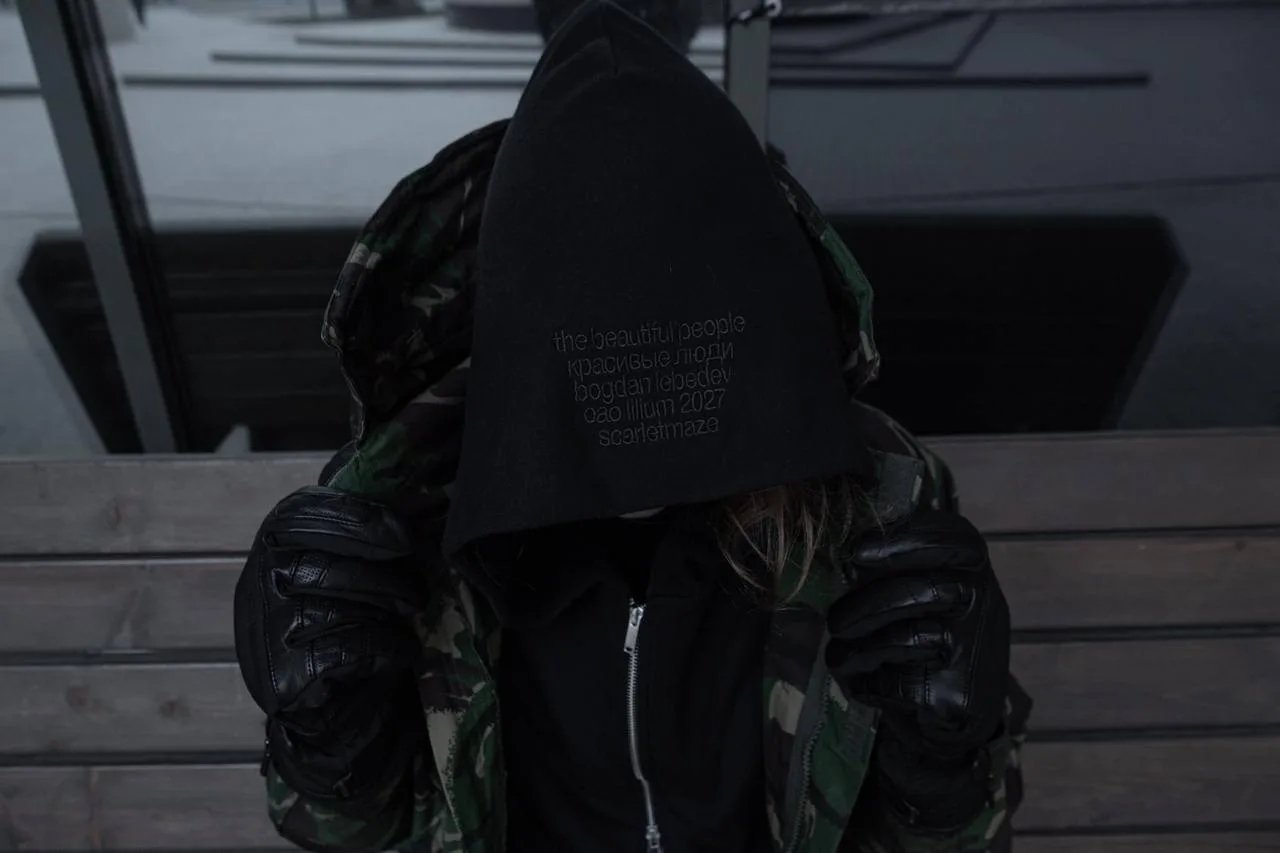
OAO beautiful people

sasha svoloch

⁂drip tech

nidgus

ORIGINS

The Story of Telegram’s New Visual Wave

The Story of Telegram’s New Visual Wave

RU

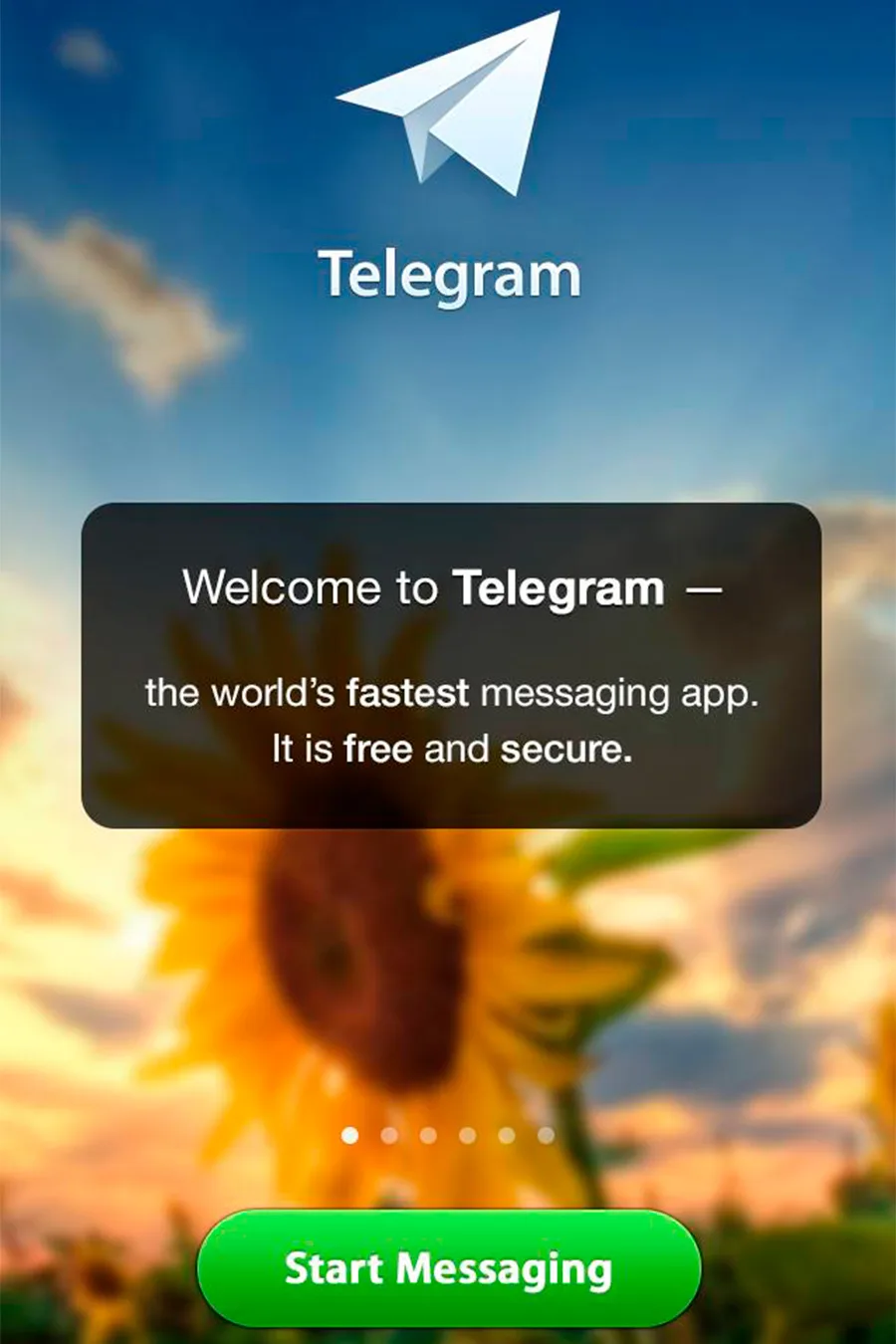
In 2014, when Telegram was just beginning to take off, it was a messaging app built to do one thing: get messages from point A to point B.

Few could have imagined that ten years later it would evolve into a super app with livestreams, games, cryptocurrencies, and NFT gifts.

But the biggest surprise was something else.

Without meaning to, Telegram gave rise to an entirely new way of creating content. Along with it came new hobbies, major media outlets, careers, and entire businesses.

When channels first appeared, they felt like stripped-down blogs with no algorithmic feed or recommendations.

The toolkit was limited to a few basics: text, images, video, emoji, and stickers.

From that limited toolkit came news channels, personal blogs, film essays, and piratecommunities.

Despite how different their content was, they all looked more or less the same: a headline, an image, and a wall of text underneath.
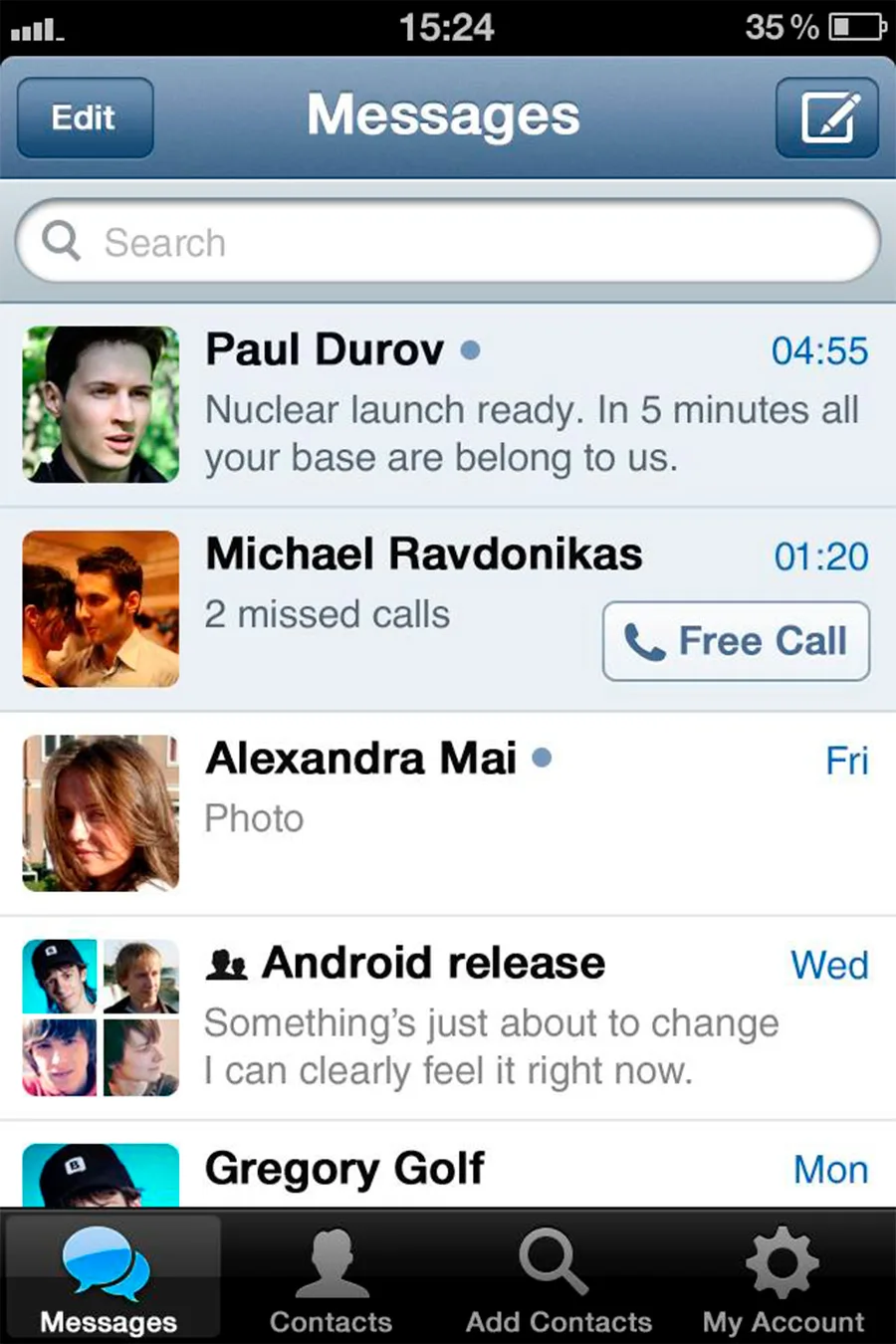
By the end of 2024, that started to change.

It turned out these tools could be pushed far beyond their intended purpose. Instead of accepting the limitations, users started treating them like building blocks.

Emoji became pixels, letting people literally embed images inside a text post. Channels built entirely around emoji art began to appear, with each post becoming its own self-contained visual composition.

These projects spread through group chats and quickly went from thousands to tens of thousands of subscribers.

Forbes would later describe it as "a new visual wave on Telegram," but at the time, few saw it as the beginning of anything important.

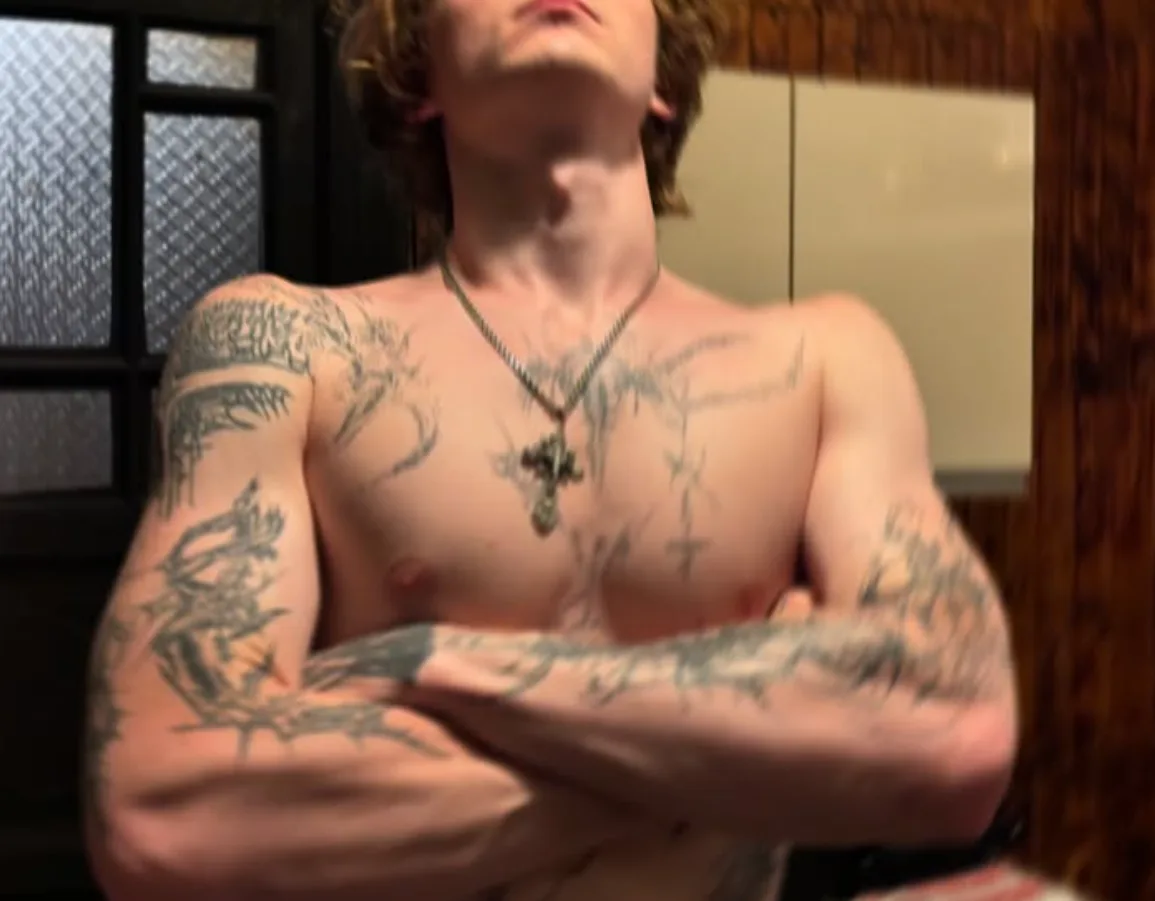
When it all began, Sasha srnk was doing something that seemed utterly pointless: trying to construct an image inside a post from hundreds of individual emoji.

How did you get into emoji art in the first place?

How did you meet Gleb? When did you become part of Solutions?

How does content for Solutions actually come together?

It all started with a group chat for my birthday, where my friends and I dumped photos from a party at a country house. Then I started posting memes, then vibe photos, then vibe photos paired with the right track, then vibe photos all in the same color palette. After that I started experimenting with things like "Women's Day," "Red Day," "PlayStation Day," and so on.

Basically, themed content.

Once I had accumulated a huge pile of images from the internet, I started making sticker packs. Then I began making visual announcements for those sticker packs. After that I started assembling compilation emoji packs and searching the internet for anything that resonated visually.

Then our art director Anna (@yaebudesign) joined in and started teaching me not to be basic or outright cringe in my design. She made sure everything we put out visually was up to standard.

After that, I decided to build a community that would actually use all of it. I started pulling in friends of friends, taking small ad placements, and designing them to break through banner blindness on Telegram. I tried to make the ads unconventional. I built the community, set up chats, brought people together, and gave them things to do.

At the same time, I was developing the idea of a "spread."

"A spread is something that fits into one screenful, creates a feeling, and stays within a single theme. Like a magazine spread."

Where did this whole story begin for you personally? How did OAO "Beautiful People" come to be?

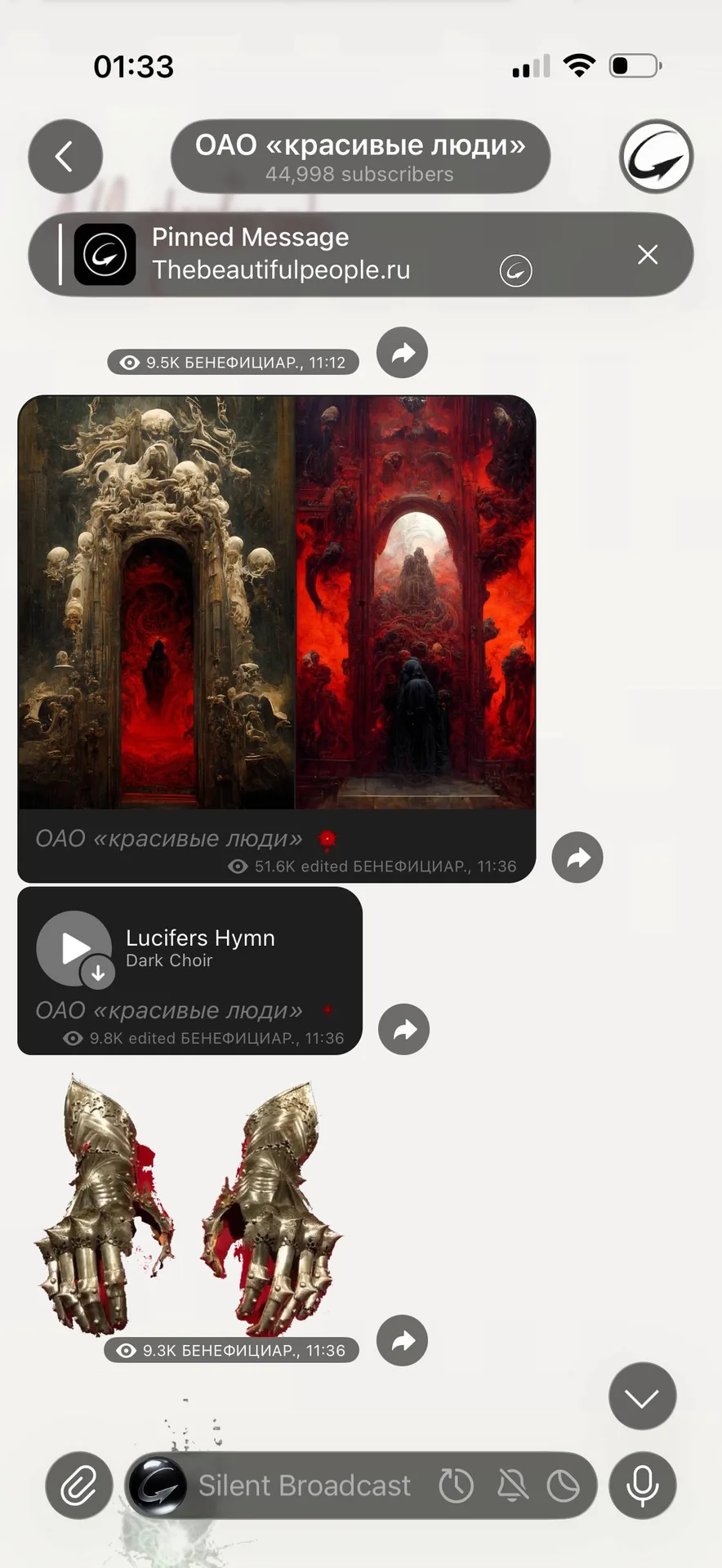
I try not to let a trend or some fan demand dictate what I do. I want to decide for myself what OAO mutates into next.

How difficult is it today to make a Telegram channel that actually looks fresh, rather than like a blend of existing references?

How do you explain your own journey from underground Telegram aesthetics to Forbes 30 Under 30?

What do you think will be the next stage of this whole "new visual wave" inside Telegram?

What do you think will be the next stage of this whole "new visual wave" inside Telegram?

Over time, many major brands become hostages to their own audience and start giving people exactly what they expect. You seem to do the opposite, constantly trying to escape everyone's expectations. Was there ever a moment when you had to deliberately disappoint people so you would not lose your own interest in the game?

OAO stands for Open Joint-Stock Company. Because it was open, all sorts of fascinating characters gravitated toward it. And while people gravitated toward OAO, I gravitated toward people who were incredibly skilled. I became an apprentice to the greats and learned business from them.

"All of this was fucking simple!"

Then I started developing the concept of "the gut." That is when a spread is longer than a single screen. Two swipes long, for example.

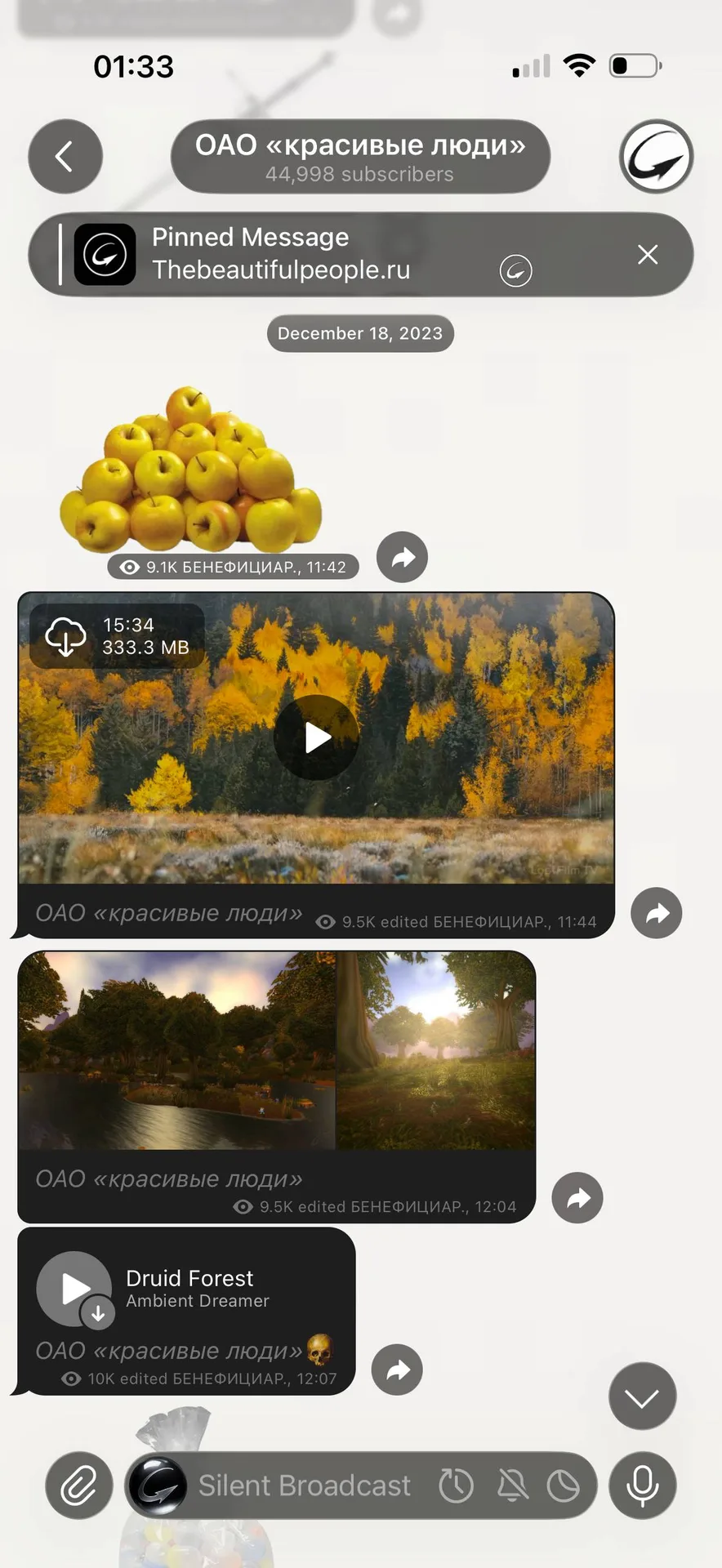
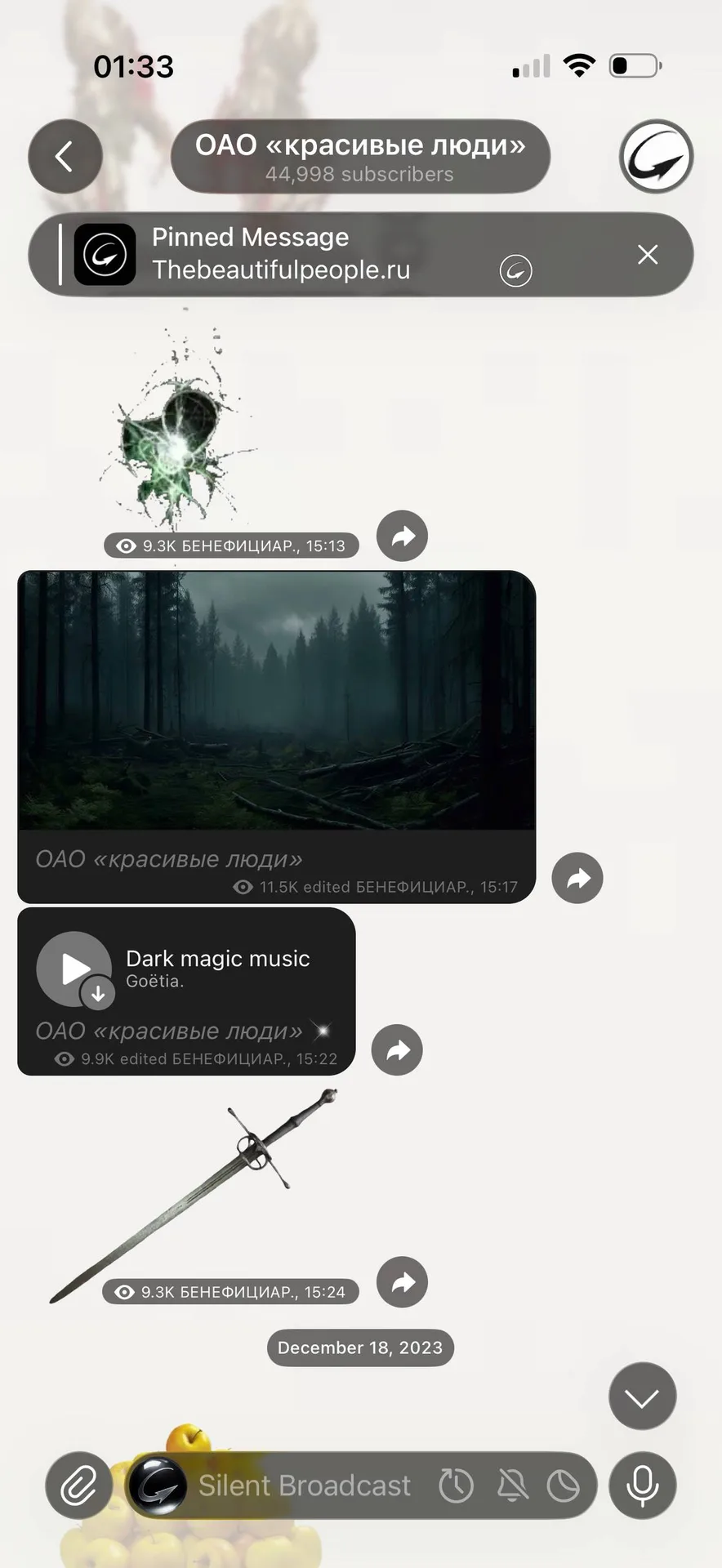
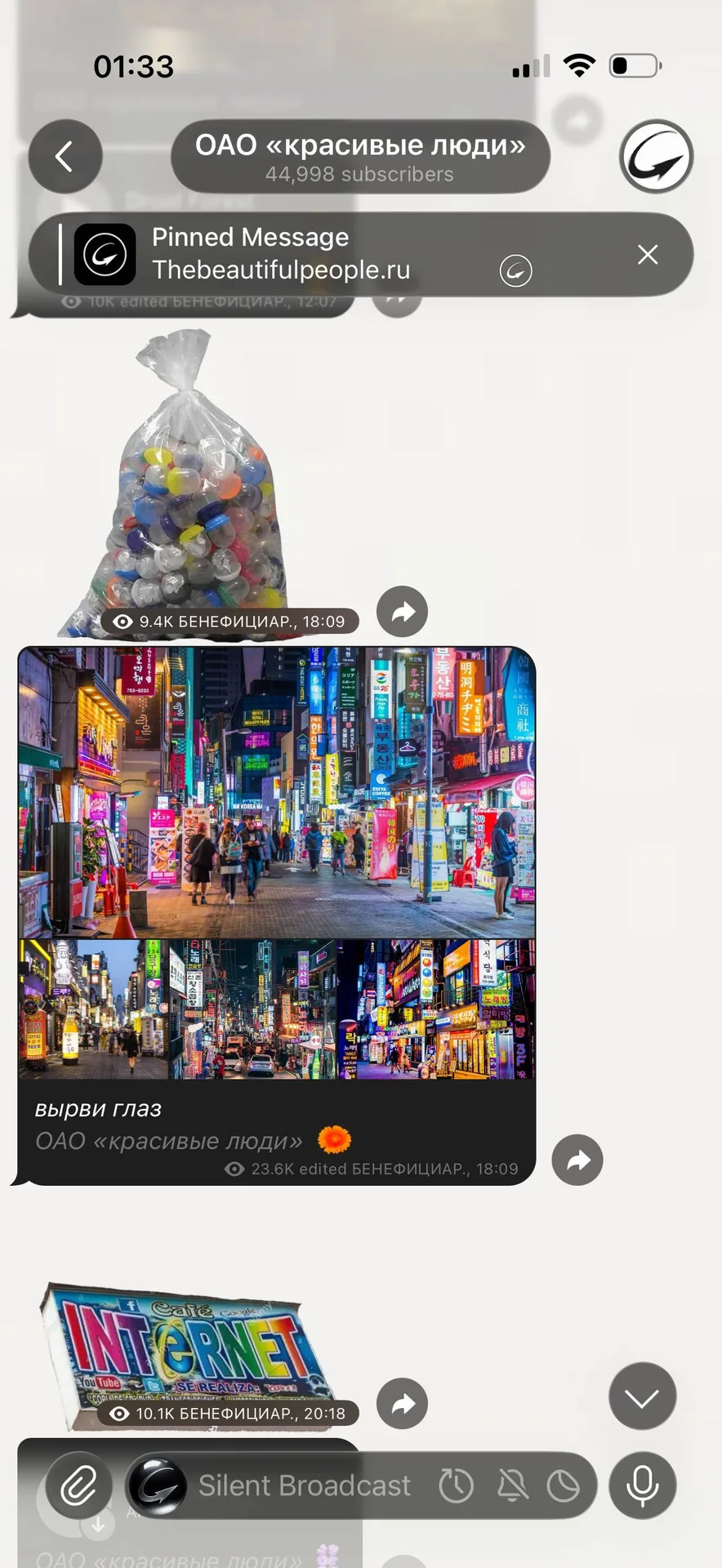
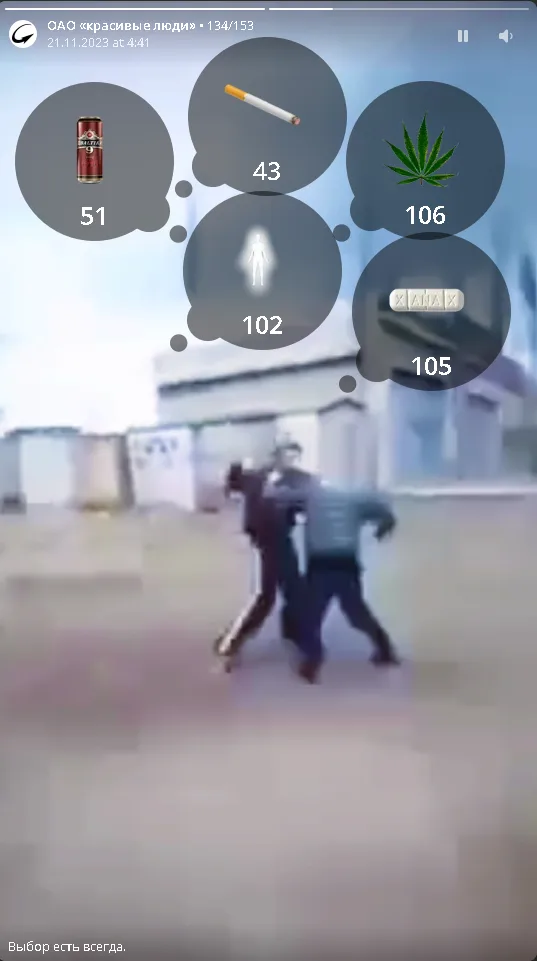
After that, I started taking over the entire screen: the pinned post, profile picture, background, Stories, and the ring around the profile picture. I created this thing called "interactive Stories," where you add sound and buttons to an image, and people feel like they are pressing something and getting a response.

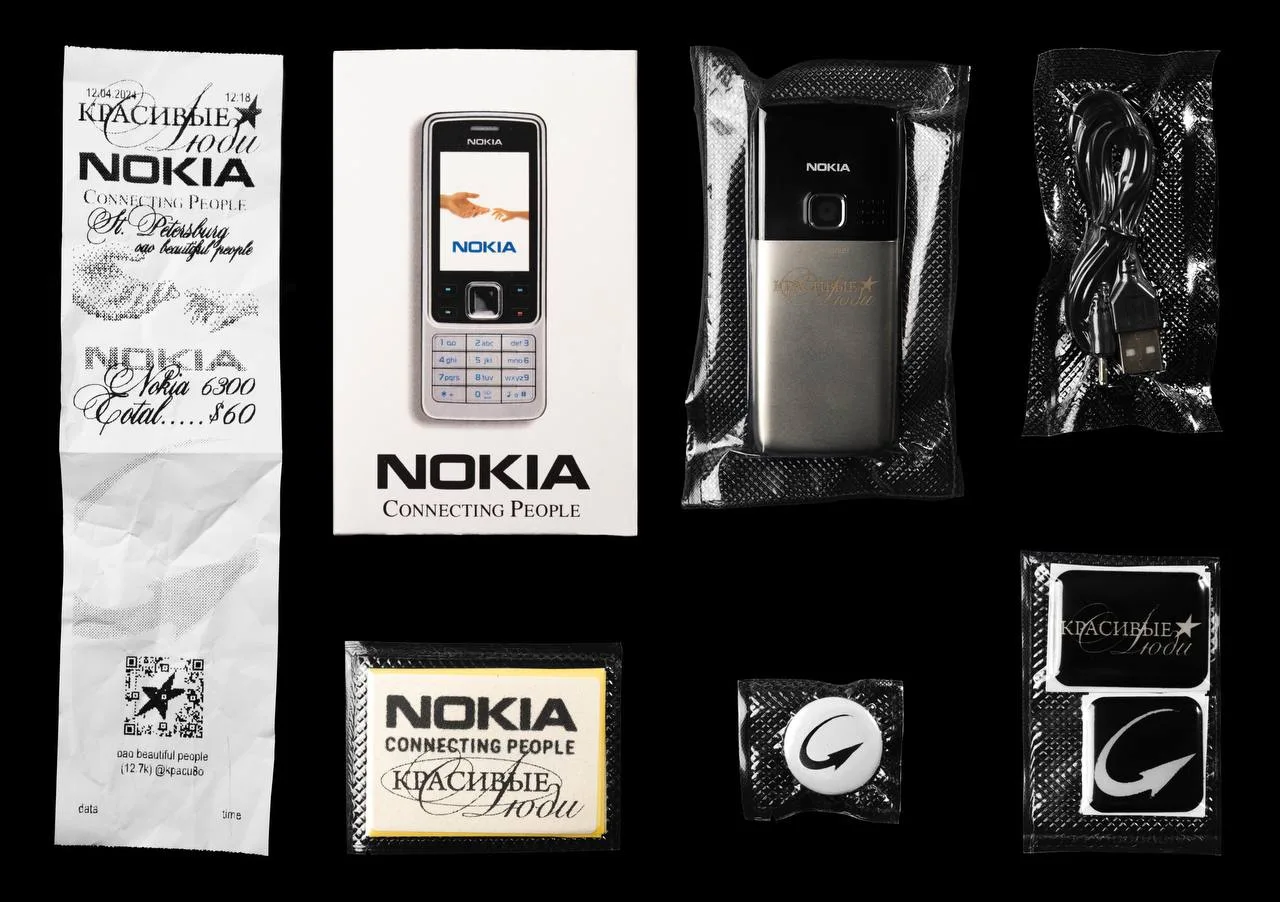
At the same time, I was trying to develop the physical goods side of things, because objects are a language people understand very easily.

I kept developing the design studio and everything else so that nobody could put me into a single category. Every individual niche already has its top three players, and it is hard to squeeze in beside them. So I became something like Invoker. If you are good at many different things, it becomes harder to associate you with any one of them. You are not standing shoulder to shoulder with anyone. You stand apart, and people notice.

Then I started applying the "zima blue" concept, taking over more and more of the screen and more and more of people's attention. Eventually it reached the point where I now give them ways to stay connected: a mobile carrier and a VPN, along with IRL events, design education programs, jobs at different companies, and internships. Plus stickers, emoji, a music bot, widgets, Telegram themes, wallpapers, online CS tournaments, and so on.

Then I started applying the "zima blue" concept, taking over more and more of the screen and more and more of people's attention. Eventually it reached the point where I now give them ways to stay connected: a mobile carrier and a VPN, along with IRL events, design education programs, jobs at different companies, and internships. Plus stickers, emoji, a music bot, widgets, Telegram themes, wallpapers, online CS tournaments, and so on.

"The main rule of OAO is that, ideally, each move should ideally be harder than the one before it. That is the law of OAO's evolution. Adaptation and evolution."

"Everyone has money, but I am the only one who has my objects. I am the hand giving the object, not the hand asking for money."

I was just rapping. I was not thinking about it. It is simply life, my diary, a chronicle of what I was doing, who I was with, and at what moment. I trusted the process, made things for myself and my friends, and let other people get into it. I did not chase anyone away or look down on them.

A piece of clothing, a course, a digital product, an event, or a collab is just a variable that lets you demonstrate how loudly you can make noise online. And the need for a distinctive visual language is a fucking brilliantly executed solution to banner blindness.

"Normal brands run campaigns and marketing to sell the clothes. With me, the clothes, or whatever the phenomenon is, exist for the sake of the campaign and the marketing."

"Doing DripTech, stickers, emoji, image wankery, 3D CGI AI shit right now is already bad taste. I recommend going back to photos and video and stopping fucking around. That card has been played. Goodbye."

You need to create your own games. Your own meta. If you think within the rules of someone else's game, all you will produce is another variation of something people have already seen.

Nobody needs channels polished within an inch of their lives. In an overcrowded world where everyone endlessly quotes everyone else's work, people need something that gives them a new emotion or feeling. And you clearly do not get there by browsing Instagram, Pinterest, or Telegram for references and trying to imitate somebody.

"Nihilism, bitches, money, power, drive, leadership, boiling blood, and the refusal to spend a single day in the same position, state, condition, or status as the day before. The refusal to be a button or a function. A hunger to study, create, make realities resonate, pull strings, and impose my own."

"So the journey from a group chat full of country-house photos to a magazine headline is nothing. The only thing easier is becoming a famous rapper."

If you follow a plan made up of small elements, you can build something enormous. It is like LEGO: the structures can be huge, but the pieces are always small.

At some point, people dug iron out of the ground and, by following a plan through a sequence of elaborate manipulations, turned it into interplanetary spacecraft.

Where it goes from there is more complicated.

I think that in half the cases, the people doing this simply do not understand the actual substance of what is happening. They want something similar for their channel, so they commission it from someone who is only there to execute and, deep down, does not give a fuck. That person is not going beyond the brief or the task they were given.

In the other cases, it is some young guy simply copying what he saw."Someone without the creative ability to think beyond the frame.".

The problem is that nobody has yet properly figured out how to immerse a person more deeply in the visual and contextual reality being created.

"If no fucking incredible updates happen at all, the visual wankfest will settle down, cool off a little, and survive in a weakened form across certain publications, brands, and so on. It is like a linguistic system: once it is there, it stays. You cannot erase it anymore."

I think we are heading into stagnation or a plateau for the next two or three years, at least until new capabilities appear within the Telegram ecosystem.

After that, maybe we will be able to go even deeper. Though I doubt it. The platform would need more customization tools and more ways to work with communities.

Telegram is basically an open-source system. We use all kinds of hacks and workarounds inside it to make different things. Some of it is limited by imagination, and some by technical capabilities.

Although, honestly, I think I disappoint someone on a regular basis.

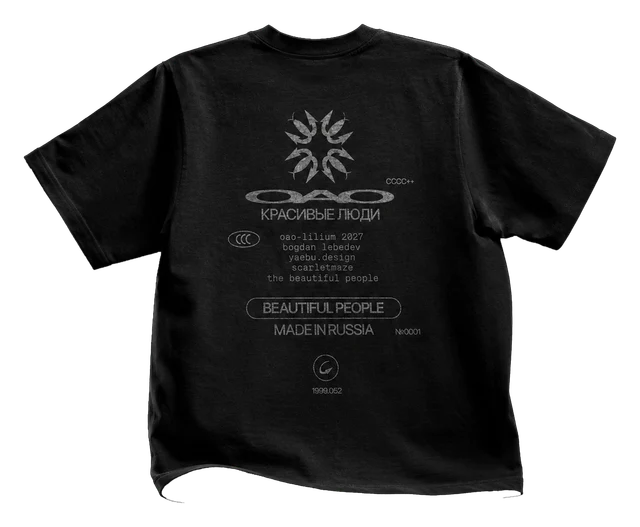
I might be slow with shipping. I might accidentally sell T-shirts with a print that later starts crumbling off. I might say I will do something tomorrow and then not do it.

"Well, what the fuck... I am doing the best I can. Right now, this is what my best looks like. Anyone who does not like it should jump ship."

Overall, I take a pretty simple view of it. Any purchase from me, or any way of taking part in what I do, is a donation. It is a vote with your wallet for the chance to see what happens next.

At the same time, it is a chance to own an object from a specific period in OAO's existence. I have never tried to disappoint people deliberately for some kind of effect.

"I am happy to impress people. But sometimes I drop a dud. It happens."

The aesthetic started spreading into other channels, attracting imitators and gradually escaping its own bubble.

Perhaps no project illustrates that transition better than .solutions.

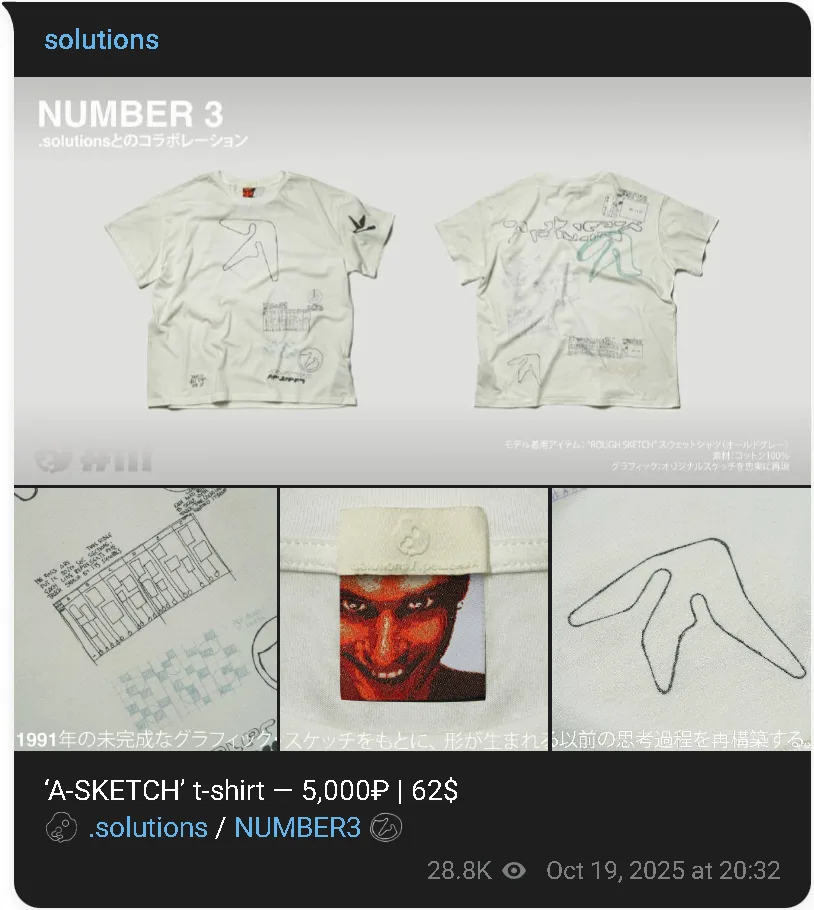
It is difficult to describe it in conventional terms. Technically, it is a clothing brand. In practice, the clothes have always been just one part of a much larger structure.

Gleb Kostin has always built an entire cultural context around it. Clothes, objects, visual experiments, inside jokes, characters, collaborations, and digital artifacts all existed within the same frame of reference and constantly pointed back to one another.

For the same reason, Telegram quickly stopped being just a place where .solutions posted announcements.

Posts began serving the same purpose the clothes once had. They told stories, set a mood, created a sense of belonging to a particular scene, and made the brand recognizable without a logo.

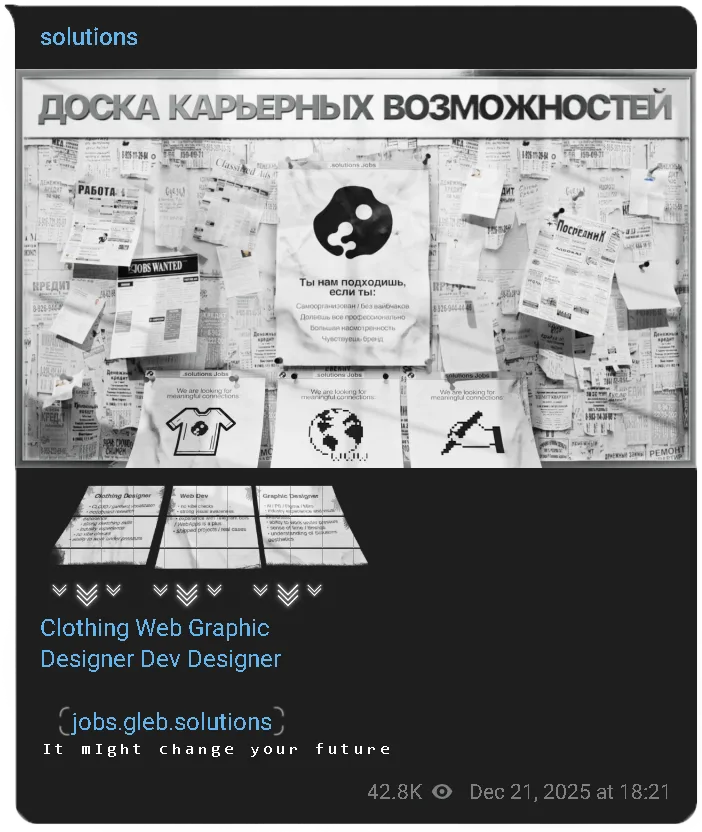
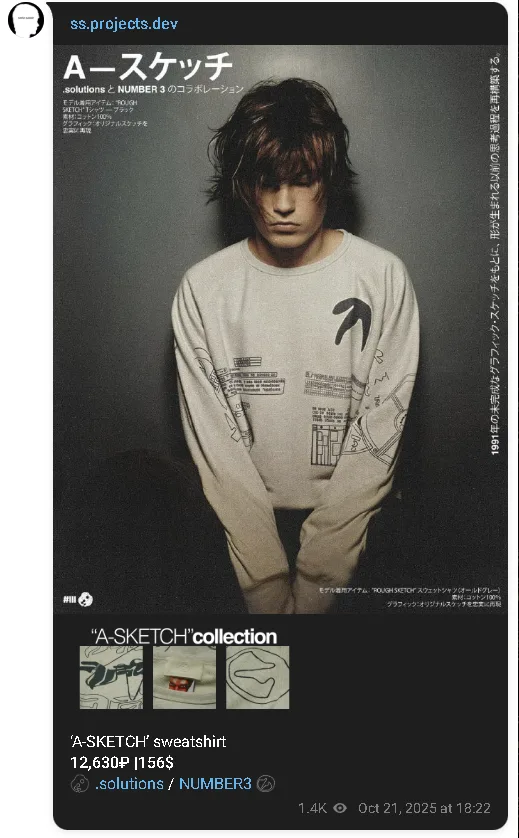
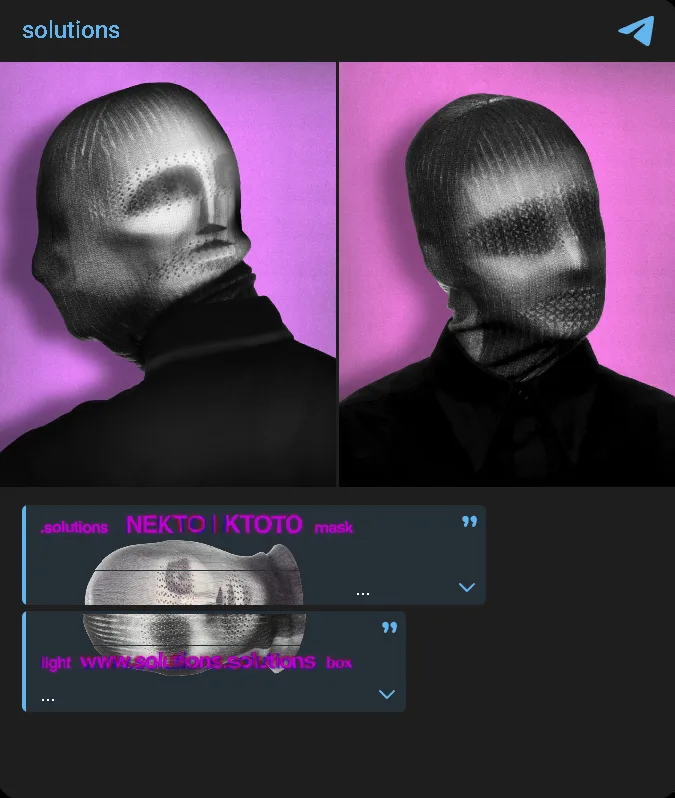
Much of that work was handled by sasha svoloch, who joined .solutions at the exact moment Telegram was beginning to evolve from a communication channel into a creative discipline in its own right.

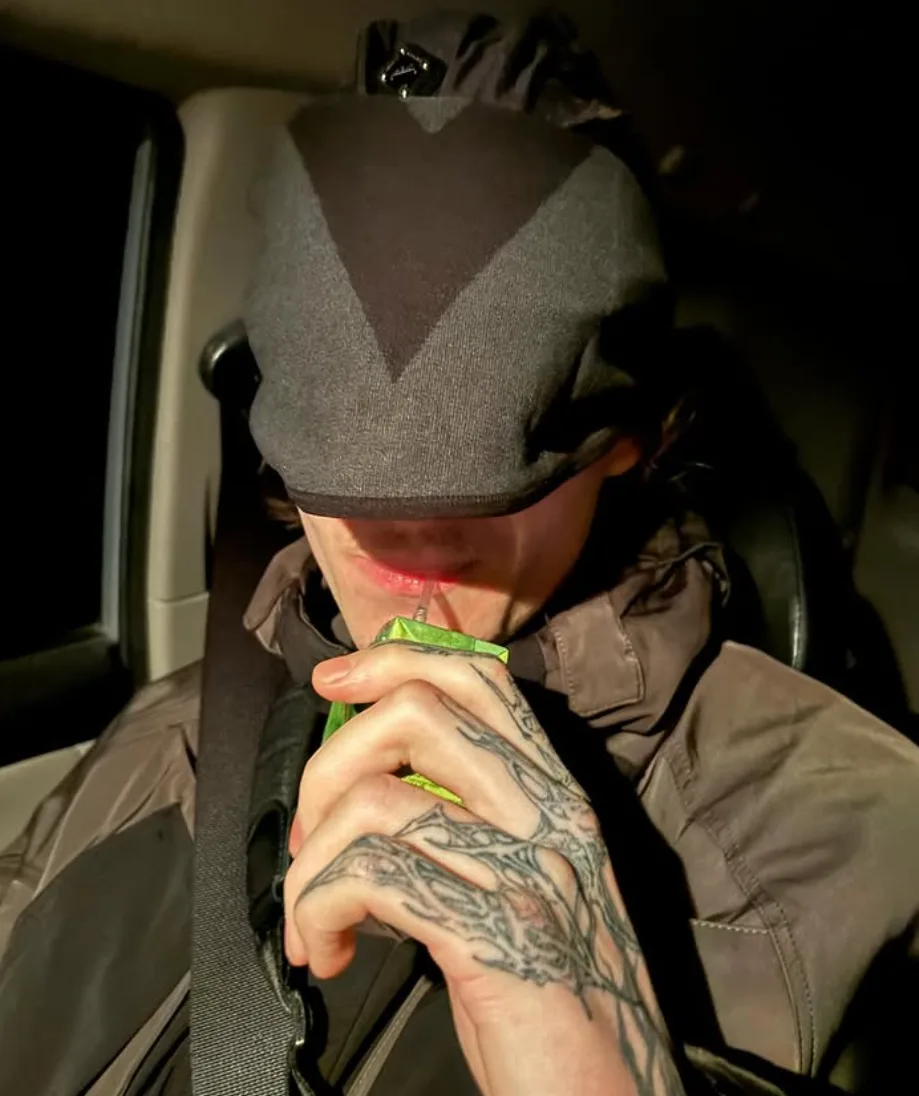
It was autumn 2024, and Solutions was holding a model shoot. The photographer @geneva invited me to take part as a model. They shot some photos of me and tagged me on Instagram. By coincidence, I had just published a post saying I was open to collaborations.

A couple of weeks go by, and a comment from .solutions appears:

"Hey, message us."

So I did. We started talking, and I told them what I could do.

The first things we made together were exactly those emoji experiments of mine.

I made these tiny emoji compositions. Then I started designing the drops. And essentially, what I started doing back then is still what I spend most of my time doing now.

How did you get into emoji art in the first place?

I first started noticing it sometime around the middle of autumn 2024.

At first, they were just small experiments.

There was pixel emoji art in .solutions, for example, where three to six tiny emojis would form a single image. Then came the .solutions promo codes.

Gradually, this stuff started showing up everywhere. I wanted to try it because it offered a new way to move beyond ordinary posts. By then, people had already learned how to make video messages, lay out images, and assemble different things inside Telegram. I wanted to find something new.

I remember making my first animations entirely by hand. I rendered every emoji separately, then manually sliced everything into 100x100-pixel pieces. One image was made up of eighty emojis, which meant preparing eighty separate files, running each one through an encoder, and uploading them one by one through Sticker Bot. I think I only got it right on the third attempt.

"I remember it being a complete fucking nightmare. The first time I did it, I sat there for three or four hours."

Then DripTech appeared. I started using it heavily and talking to Alim. At the time, there was still no proper way to upload transparent PNGs, so everything had to be done with chroma keying and various workarounds. Once it became possible to upload files normally, it completely opened things up.

I have been using it constantly ever since, waiting for Telegram to come up with something new.

With every project, we try to make the process more systematic, so nothing is a shot in the dark and everything follows a clear logic.

Usually, a drop is coming up. A message from Gleb appears in the work chat. There is a new task.

Say we need to find a way to highlight the SIM cards and play with the idea. Sometimes the overall direction is set immediately. A story about microchipping, for example.

At the same time, it is obvious that the post needs to contain a lot of information. You cannot communicate an idea like that through pretty pictures alone.

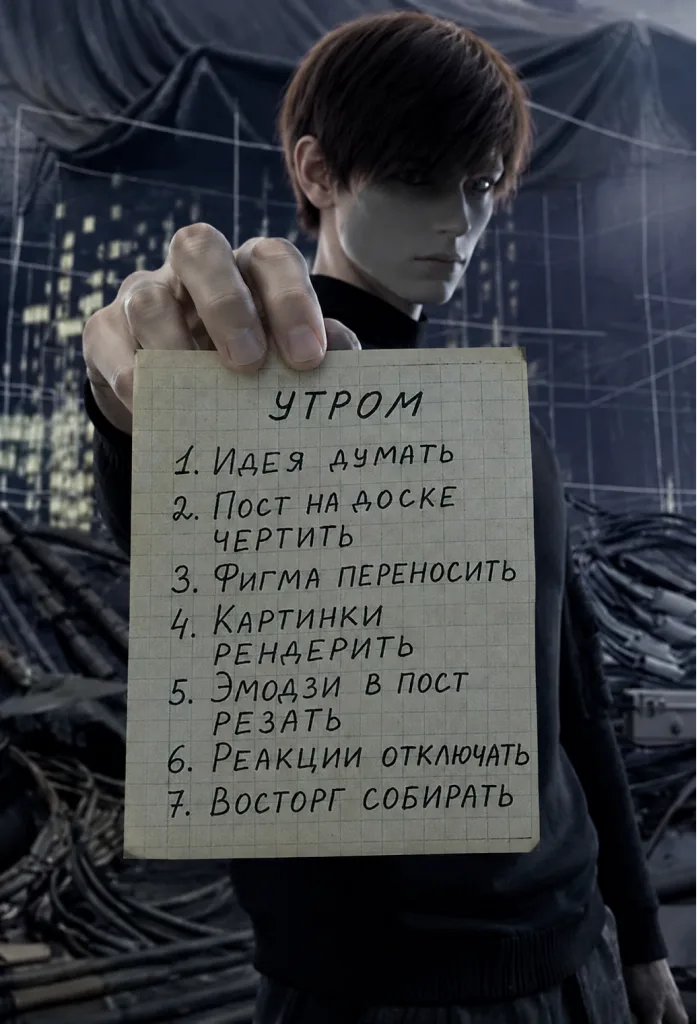
First, we sketch everything out. We plan the transitions. What will be an image? What will be a video message? What will be text?

Then we put together several options, present them, choose the best ones, refine them, and start producing the final version.

Sometimes an idea looks good at the sketching stage, but later you realize that everything needs to be reinvented from scratch.

The approach itself always stays the same.

sasha svoloch

CG artist & concept designer

at .solutions and ihavefabrics

Because when you are speaking to an audience of tens of thousands, people need to understand exactly what you are showing them. Meaning always comes first.

Legend has it that Sasha Svoloch sketches his posts on a whiteboard first. Is that true?

Yes, it is.

Either a whiteboard, or paper and a pen.

If you open Blender or Telegram straight away and try to build everything there, it is incredibly easy to get lost.

It is literally a previsualization stage. First you need to sketch it, understand what goes where, and only then start assembling, generating, and laying everything out.

You genuinely cannot do without it.

Would you say Telegram has already become part of the Solutions brand identity?

I think so.

The thing about Solutions is that the drops can be completely different. One has one kind of lore, another has something else. One is entirely black and white, another is green, another is blue.

From the outside, it can look chaotic, yet it still feels like the same channel. That is because there are brand guidelines, a set of fonts, rules for presenting information, and a list of things that must remain consistent regardless of the particular drop.

"It should not only look good. It should be informative too."

"All of it comes together to create the feeling of a single brand."

"That is a huge difference."

Why has Telegram proven so well suited to visual experimentation?

On Instagram, you scroll through an endless feed. Something appears in front of you, and you immediately keep moving, unless you are a die-hard fan of a particular brand or person.

Telegram is different.

"Say I follow SRNK. I see a new post and tap it. It feels like I have opened a door and stepped inside. I have already chosen to look at it."

That means you can make more complex things here. People are prepared to pay attention. They come here to learn something.

What is the most complex emoji art you have made?

That means you can make more complex things here. People are prepared to pay attention. They come here to learn something.

"That is a huge difference."

The main question is no longer how to assemble the emoji, but how to make the medium itself unique. Because back then, any picture built out of emoji already looked like magic.

Now it's usually the other way around. Clients come to us and say:

We already know how to do it like everyone else. We need it to be genuinely fucking good.

What do you usually use in your work?

To make a great post, I need a pencil, several sheets of paper, Blender, Figma, Photoshop, After Effects, DaVinci Resolve, and sometimes AI tools.

That is my main stack.

What is Telegram still missing today?

If I could ask Telegram for anything...

More emojis in a single message.

Longer animations.

Proper synchronization, because sometimes one canvas loads and the second one does not, and the entire composition falls apart.

But most importantly, hyperlinks inside custom emojis.

Right now, making a button requires a whole mess of workarounds: emojis, text, brackets, and various other hacks.

What do you usually use in your work?

Every person featured in this article mentioned DripTech in one way or another, and it is easy to see why.

If the Telegram aesthetic ever developed an infrastructure of its own, DripTech was largely responsible for it. The bot made it possible to turn images into emoji art in a matter of minutes, saving people hours of manual work.

Beyond its practical purpose, DripTech built an entire universe around itself. Its internal currency is called "chips," the referral program invites users to "spread the virus," and the support button is hidden under the word "consolation."

Endless aura.

If a custom emoji could function as a link, that would be insane.

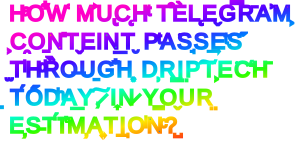
How much Telegram content passes through DripTech today, in your estimation?

6,040,911 emojis, not counting posts and stickers.

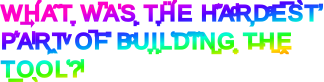
What was the hardest part of building the tool?

the hardest part isn't building it technically. the hardest part is not puking from how badly everything in Telegram begs for violence, while almost nothing in it is built for that.

one of the first driptech "user cases" was @sashasvoloch. i think his work in the very beginning gave us that reaction

overall, us and @solutions created the perfect tandem because they know how to experiment with presentation

Which project made with DripTech gave you that "this is it" feeling?

every action brings us closer to death. whether you move forward or backward doesn't matter.

if we hadn't made it, somebody else would've sooner or later.

you could say the same about the creation of the DAW, that it killed "classical music", but we think everything has its time.

there was a filter and a pose.

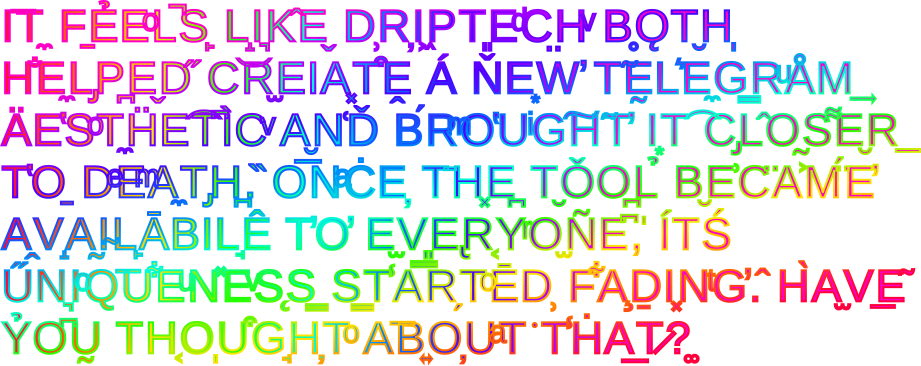
It feels like DripTech both helped create a new Telegram aesthetic and brought it closer to death. Once the tool became available to everyone, its uniqueness started fading. Have you thought about that?What would your life look like today if Telegram had never introduced custom emojis?

batch uploading/adding stickers. a meaner API. native 3D.

more freedom for packs, storefronts, reactions, private mechanics, internal economies.

Pasha, we'll take it from here.

What would you ask Durov to add in future updates?What is behind the way you communicate on the channel?First impressions of the update?

Interestingly, right in the middle of our conversation with the DripTech team, Telegram released one of its most unusual updates in years.

Thirteen years after the messenger launched, it finally introduced full post formatting.

Images, video, and audio can now be embedded directly into the body of a message without any third-party tools.

That raises an interesting question.

DripTech essentially allowed users to turn images into emoji compositions and embed them directly into the structure of a post, giving Telegram a feature the platform itself never originally had.

Now some of those capabilities are becoming native. So the main question is not even what happens to DripTech, but what happens to the entire aesthetic that grew out of the platform's limitations.

Telegram is tumblr now.

this will only be good for DripTech.

complex systems = more bugs.

By 2026, Telegram's visual culture had grown into a design market with its own tools, studios, and contractors.

Large companies were trying to understand why some channels felt alive while others looked like soulless feeds of press releases.

Gradually, asking for a Telegram channel «like Beautiful People» stopped sounding unusual. Clients wanted video messages, emoji-built posts, and the feeling that there were real people behind the channel, not a brand.

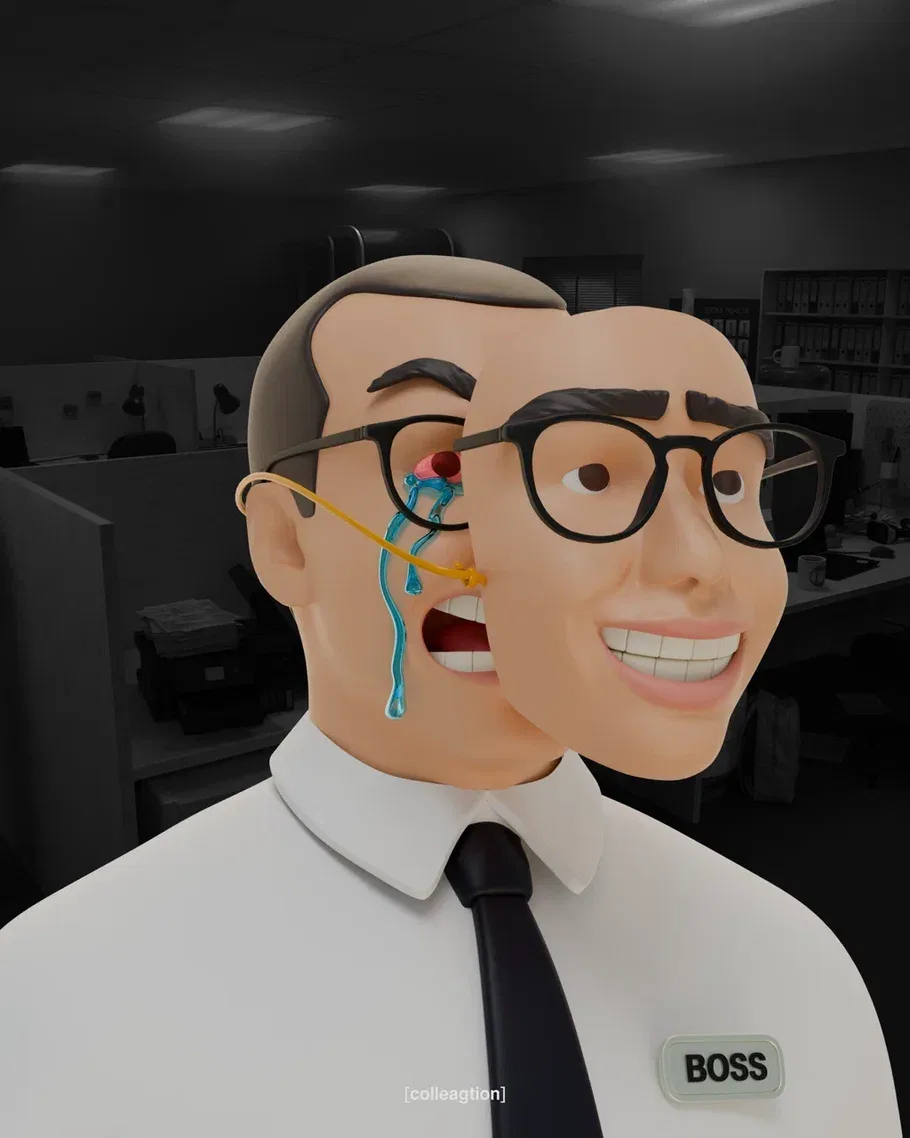
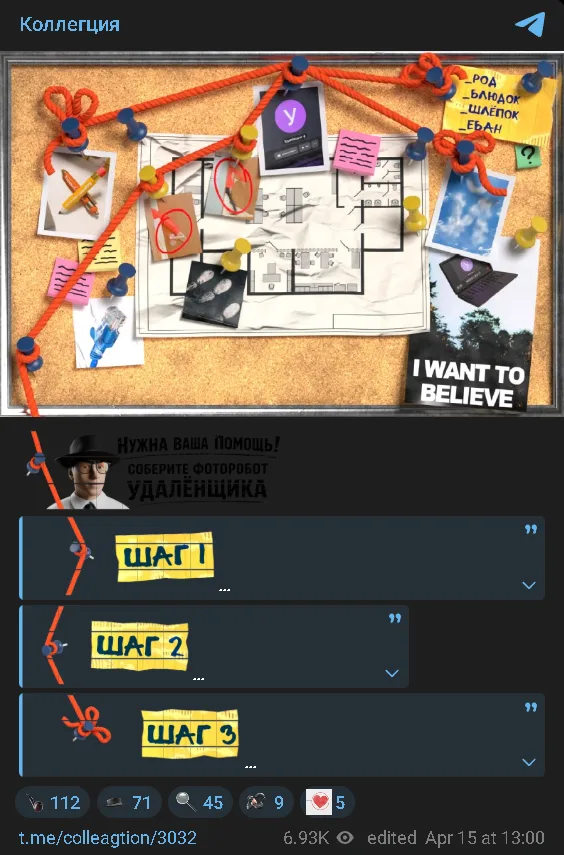
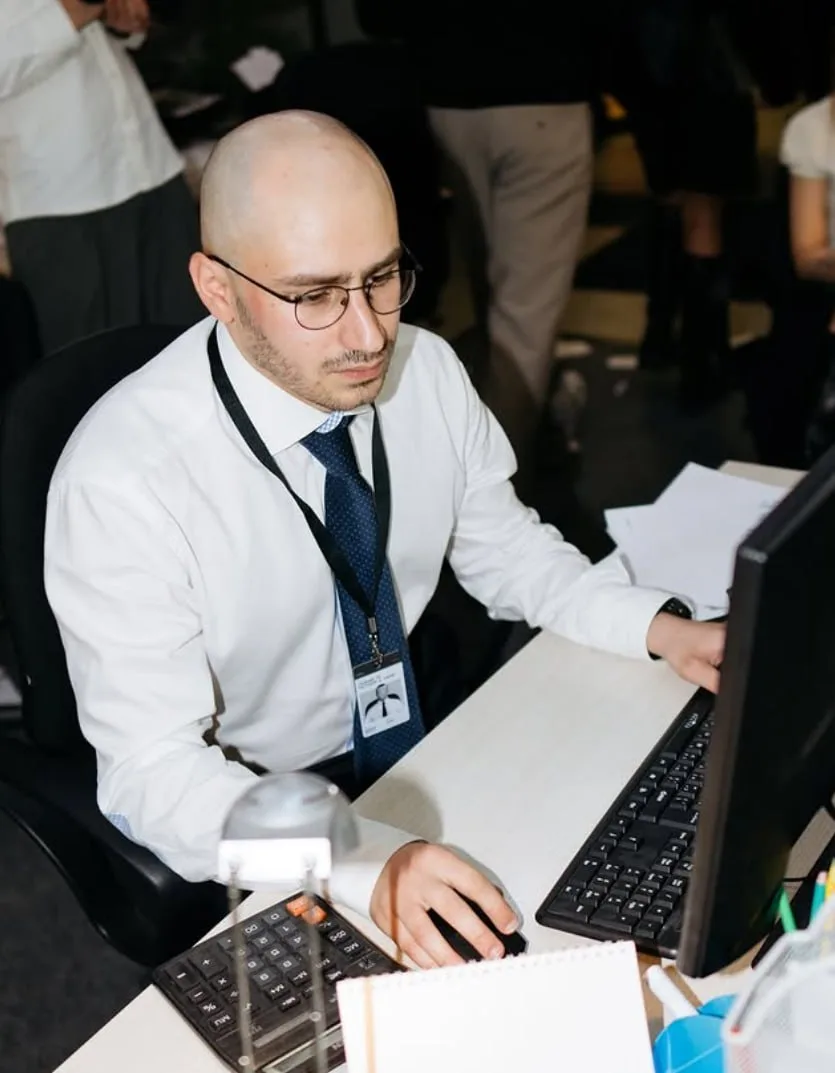
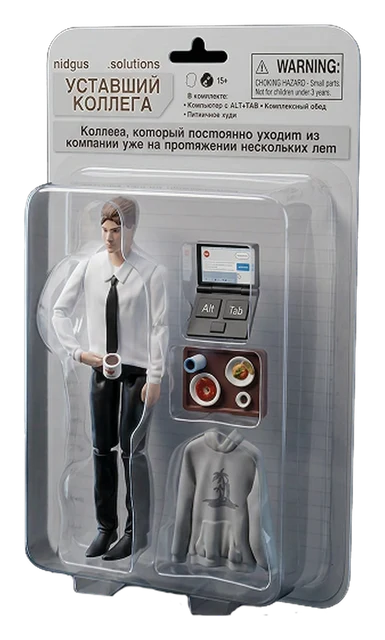
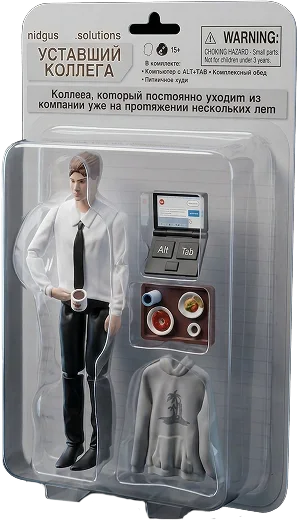
One of the most visible figures in this space was Nijat Huseynov, the creator of Colleagtion.

He made collectible toys inspired by office life, worked with emoji art, and launched projects for IT corporations and grocery retailers.

Telegram News

Rich Text Editor. You can now create articles and long posts in a visual editor that supports dozens of formatting options and allows you to generate text with privacy-conscious AI tools.

July Features
1234More

t.me/telegram/450

Honestly, we usually don't have to explain anything. In 99% of cases, brands come to us themselves after seeing one of our posts or images.

When it comes to corporations, they are watching. And somehow, the core of our audience today isn't white-collar workers, but the creative crowd inside large companies.

SMM managers, creatives, marketers, and other people who work inside corporations and are constantly looking for new formats. They saw us doing something unusual with fairly ordinary office themes and started following us.

Yeah, yeah.

Usually, we just show examples of what it could look like. Then the client says yes or no. But honestly, we almost never sell composite emojis as a standalone thing.

When someone comes to us saying:

We're more likely to propose a full interactive day built around a specific occasion or date. And one of its elements might be some elaborate-as-fuck post assembled from an image flowing into emojis, emojis flowing into stickers, and so on.

"We want to make something, but we have no idea what."

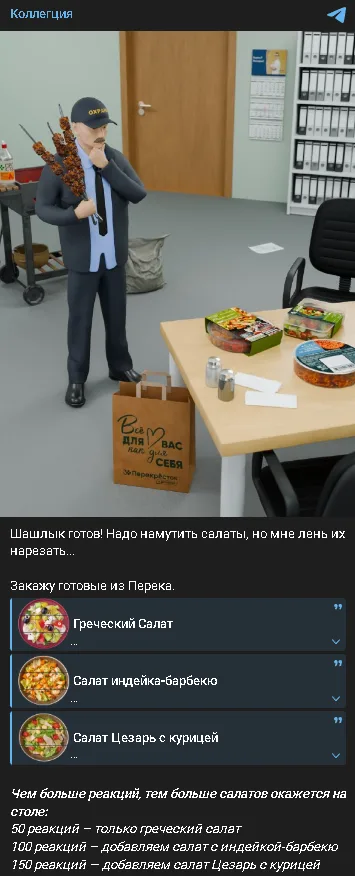
We did something like that with Perekrestok. We went fucking nuts with stickers, emojis, and everything else. Judging by the reactions, it worked insanely well, especially considering it was an ad.

Even so, we still don't position emoji-driven concepts as a separate product.

"We are extremely meticulous about composite posts. They are difficult."

On the other hand, we're constantly watching what other people in the market are doing, and we get inspired ourselves. We sit there thinking:

"Damn, we need to use this too."

When you consider yourself a creative person, you naturally want to use tools like this and translate them into a format that an ordinary user can understand.

"Haha, that sounds extremely corporate."

Yes. And it's also a competitive advantage.

When you make these intricately constructed posts, it automatically boosts your creative aura. People open the channel and see that somebody built an entire system for a post that could have been just text or a single image.

Essentially, Telegram's capabilities created an entirely separate market for creators and companies like yours. Before, you could sell a post, a Story, and maybe something else. Now you can sell composite posts, emoji mechanics, and other similar things as separate products.

I agree that if this kind of content appears without context, part of the audience may genuinely scroll past it.

"Why does this look so fucking good?"

Don't you think posts like that can become too difficult to process? That something which works for Solutions fans and people who enjoy this kind of content might be confusing to the audience of an ordinary company?

I agree that if this kind of content appears without context, part of the audience may genuinely scroll past it.

But a lot depends on the audience itself.

Because there might be something fun inside.

"And that expectation of something fun plays a huge role."

"The more feedback we get, the better we understand what we're doing well and what we're doing badly."

You need to create the sense that any post might surprise you somehow. Maybe you can win something. Maybe there's a giveaway. Maybe there's an inside joke hidden in there that only people who read to the end will understand.

It's more or less the same with reactions. We still haven't disabled them because we see them as part of our interaction with the audience. Feedback matters to us.

"The more feedback we get, the better we understand what we're doing well and what we're doing badly."

So this is already a primed audience. When they see another post made from composite emojis, they don't come to it cold. They see it through the lens of everything we've done before. That makes the surprise hit even harder.

The conversation usually starts very simply:

"Damn, Nijat, hey. How much would a post cost? What are the terms for a collab?"

Recently, I even saw an interesting phrase in a commercial proposal. They described it as a separate genre:

"Posts with composite emojis and lists."

"They haven't just been buried. They've already rotted."

"Damn, some trend is working. Let's take it and post it."

That will be cringe.

Even we sometimes use memes that died a long time ago.

Even we sometimes use memes that died a long time ago.

But we rebuild them inside our own setting and add new jokes on top that work now. That takes time too. You need to come up with the idea, understand how to present it, and figure out what new thing it adds.

The problem starts when someone takes a finished mechanic and simply changes the text.

For example, we made an envelope with a message that opened up. Then somebody saw it and went: "Oh, cool format." They took the exact same envelope, changed the words, and posted it.

We look at that and think:

I repeat this to the team constantly. If we use a trend, we have to figure out how to make it better. Nobody wants to be the person who simply rewrote somebody else's draft.

"If there is a trend, you need to sit down and think about how to improve it."

The same thing happened with stamps, signatures, and other mechanics. But the point was never the mechanic itself.

Sasha from Solutions and I talked about this a lot. He told me that before assembling a post, he draws it on a board, moves the elements around, and checks how everything works. I think brands should treat these things as research too.

Sasha from Solutions and I talked about this a lot. He told me that before assembling a post, he draws it on a board, moves the elements around, and checks how everything works. I think brands should treat these things as research too.

Do large companies usually manage to enter formats like this at the right time, or do they tend to show up once the trend has almost burned out?

Damn, honestly, we don't really do that.

When people want to make something with us, we say:

"Come over. Let's make it."

The whole thing with slides about reach, views, and evidence for why the project needs to happen is very rare for us. I think it happened only once.

Colleagtion was running out of money, so we decided to put together a commercial proposal and go back to old clients. Just to cover some expenses and pay the team.

But it turned out funny. The very first client we contacted agreed immediately, simply because they were interested in trying something unusual.

If a regular SMM specialist inside a company wants to pitch an emoji-based special project to management, what should they emphasize? Reach? The trend? Brand image?

There's an important point here. If some brand guy is reading this, the point isn't whether you enter a trend early or late. The point is to come up with something of your own on top of it.

The point is to come up with something of your own on top of it. Usually, brands just take a trend and add nothing to it. That's why it comes out cringe.

Say a trend appears. The next day, a branded version of that trend comes out. Then another one. Then another. And the whole thing looks like a copy of a copy of a copy. Some trends move so fast that everyone is already fucking sick of them an hour later. Others have a little more staying power and last for a few days or a week. But brands shouldn't simply repeat them. They need to think about how to present them in a different format.

Honestly, there wasn't any grand idea behind it. It was more of an experiment. I wanted to see whether it was even possible to put together a mosaic inside Telegram, and how people would react.

I took my character Devboy and tried to recreate him entirely out of emojis.

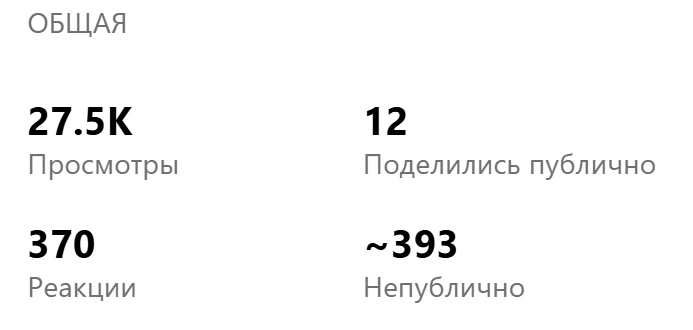
The experiment worked: the post got shared more than 350 times, which back then meant people were REALLY blown away by what they were seeing.

Haha, I even remember putting together my very first one. I had some university stuff to deal with and was headed to another city by train. The trip took a couple of hours, and I spent the whole ride sitting there with my laptop, manually assembling an emoji canvas.

First, you cut the image into 100 little squares.

Then you convert those 100 squares into Telegram emojis.

After that, you manually upload every single emoji through the official bot.

Then you repeat that whole routine another three times until you get the result you want, and you're done!

Basically, one post could take hours. Now the same thing takes literally a few minutes, thanks to specialized tools.

27.5K

12

370

~393

Views

TOTAL

Shared publicly

Reactions

Private

You were one of the first people to make an emoji art post. How did that happen?What did the process of making posts like that actually look like?Over time, all of that obviously became much easier. Was there a moment when you opened Telegram and realized it was becoming mainstream?What started as a creative way of styling posts eventually seemed to turn into an obsession with aesthetics.

Before bots, every emoji canvas was sliced by hand

How did those experiments affect your life?Sure!

I think there's a broader answer to that.

I think Telegram basically created a whole new service market for designers and social media marketers in Russia.

Creating custom emojis, designing stickers, and putting together posts with emoji canvases either existed on a much smaller scale or didn't exist at all.

Now every brand and company needs its own distinct way of communicating, which means more work for us.

So yeah, thanks, Durov! By the way, can I brag for a second?

I wouldn't call it my greatest achievement or anything, but Pavel has used my emojis in two of his posts (1 and 2).1 and2)

That really fires me up.

I'm basically one emoji handshake away from Durov.

I don't think there was any one specific moment.

I just gradually started noticing more and more channels doing similar things. Around the same time, dedicated bots like DripTech started popping up, and a lot of things could already be automated.

That was what I loved most, because it felt like I'd somehow made my own small contribution to the whole thing.

Yeah, 100 percent.

With emoji-based design becoming a trend, every creator is trying to make their posts more and more unique.

As a result, posts become overloaded and start feeling more like images than text that's actually meant to be read.

BUSINESS

INDUSTRY

CULTURE

INFRASTRUCTURE

I used each product as a framework, creating a financial model that built marketing into the economics of the project and made the whole thing pay for itself.

It turned out that people cared not only about what they were reading, but also about how they were reading it.

Posts, Stories, channel design, advertising, and even the pauses between posts started merging into a single experience. At first, this worked well at the level of individual posts. But it quickly became clear that the same building blocks could be used to create more than isolated pieces of content. They could be used to build entire worlds.

That sounds grandiose, but it is hard to describe it any other way.

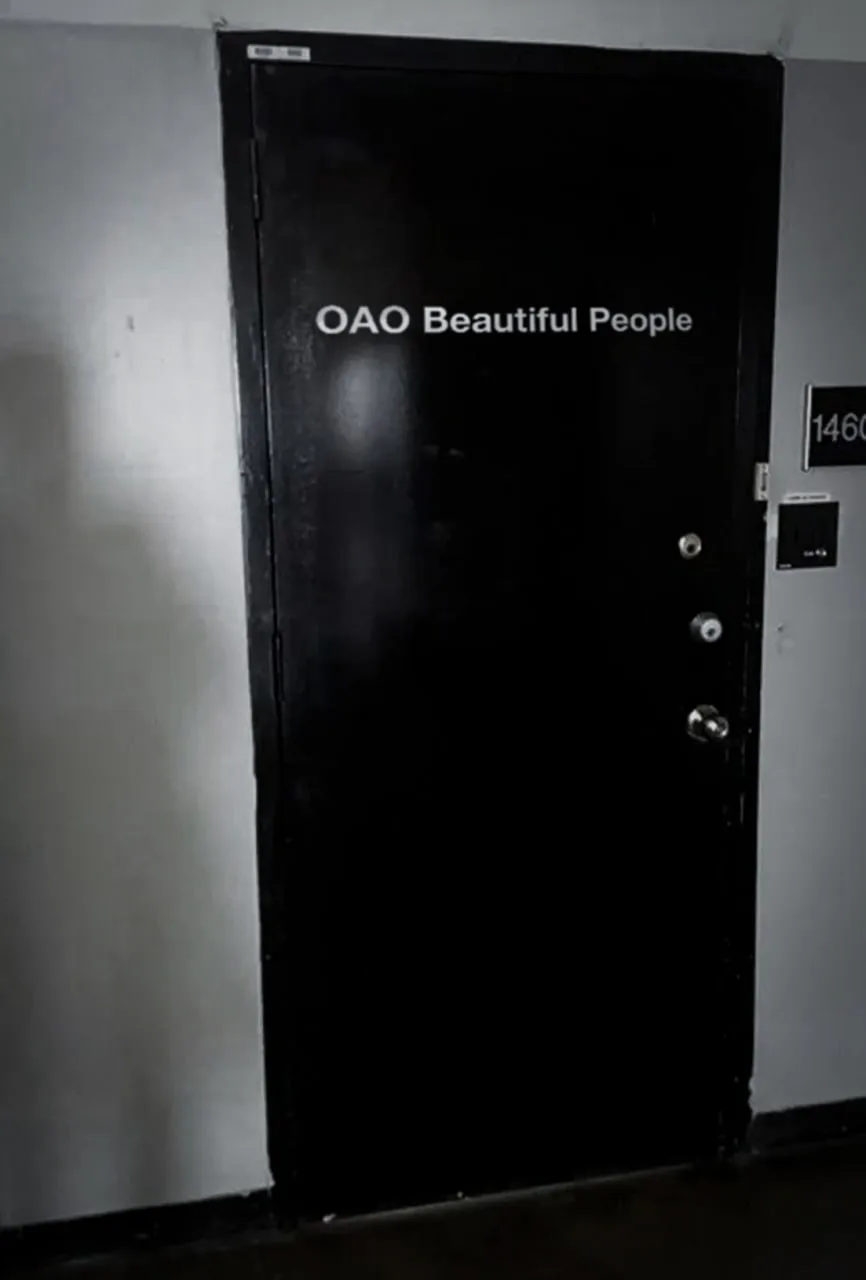
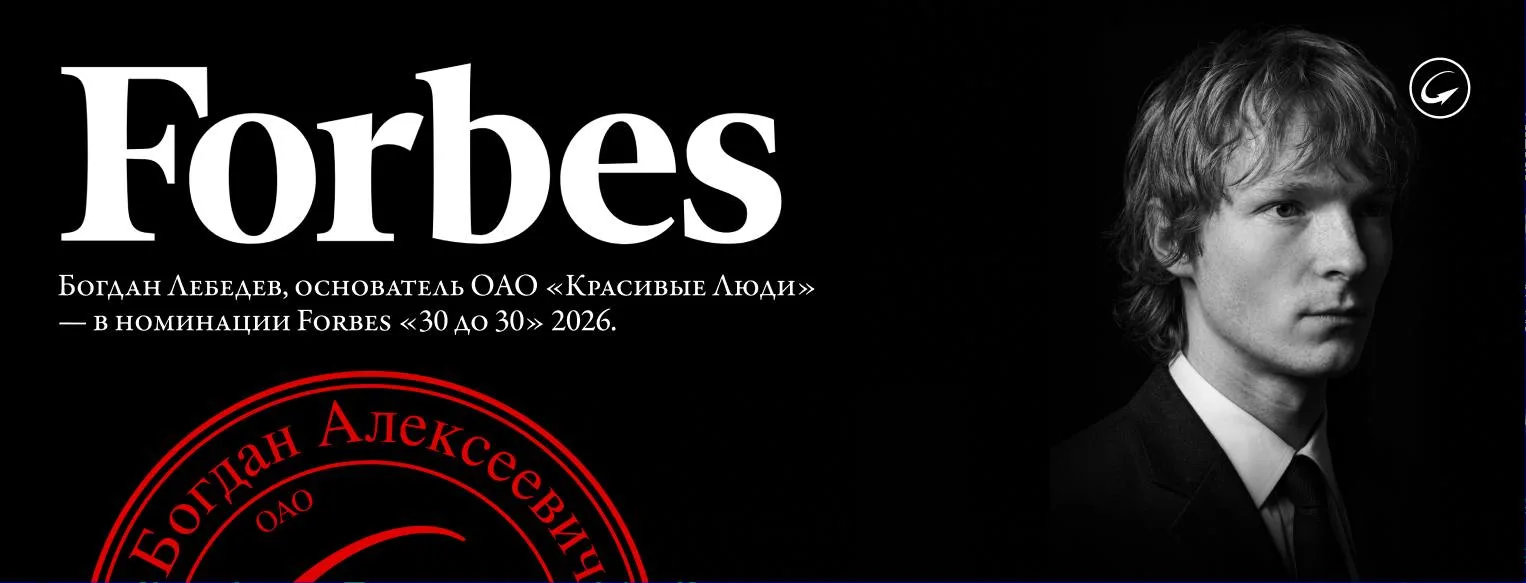
One of the clearest expressions of this approach was Bogdan Lebedev's OAO "Beautiful People".

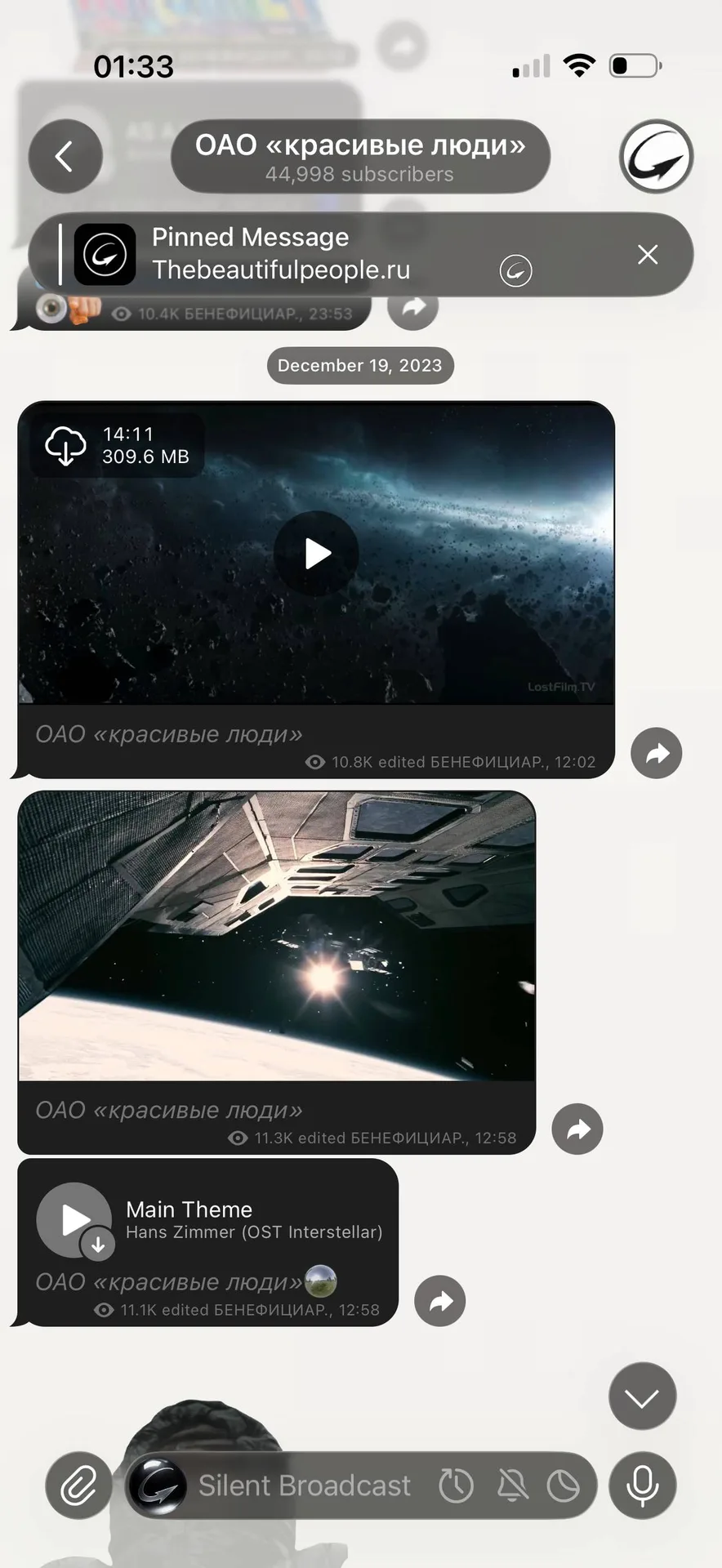
By the time this article was published, more than 45,000 people were following OAO, and an entire ecosystem had grown around it, complete with connected projects, its own services, physical objects, events, and inside jokes.

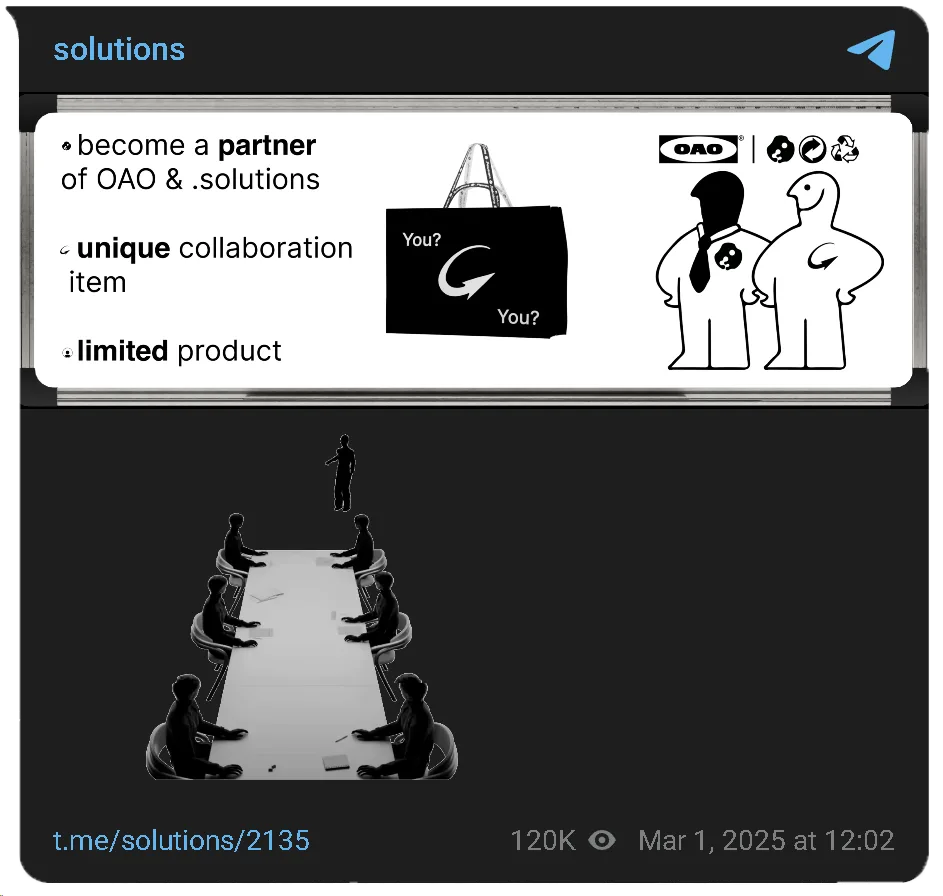
Take Solutions.

Sasha and his team have pushed it almost to its absolute limit. Every information-heavy post turns into a puzzle you have to unpack just to understand how it works.

It works on two levels. On one hand, the post is informational. On the other, it's creative. And you sit there losing your mind:

"Fuck, why didn't we think of that?"

"Damn, at least come up with something of your own on top of it."

"All of it is so my voice can sound inside their heads, the way it is sounding inside your head right now, reader. One, two, three, mic check. See? You can hear my voice inside your skull. I am in there."

The problem is that nobody has yet properly figured out how to immerse a person more deeply in the visual and contextual reality being created.

Builder, art director and pixel-art enjoer

sasha srnk

devtown

NIDGUS

CEO of Office Culture

colleagtion.com

Every now and then, I try to fill people's heads with brighter thoughts too.

If you work with corporations or collaborate with major brands, how do you usually explain the value of emoji canvases to them?

Don't you think posts like that can become too difficult to process? That something which works for Solutions fans and people who enjoy this kind of content might be confusing to the audience of an ordinary company?

Bogdan Lebedev

Serial creative entrepreneur
behind Beautiful People
and other OAO projects

Other than that, when people come to us now, I usually say:

"What reach? We don't sell reach. If you like what we do, then let's make something."

So in practice, we handle the whole thing end to end. Most clients like that approach. When it comes specifically to emojis, we simply show the options on calls and explain:

So in practice, we handle the whole thing end to end. Most clients like that approach.

We answer:

"Handle the creative yourselves. Handle the presentation too. Build the entire framework."

Now it's usually the other way around. Clients come to us and say:

It's more of a brand-building project. Guaranteeing numbers on algorithm-driven social platforms is extremely difficult now anyway. On Telegram, you can look at a channel's average views and get a rough sense of the scale, but we don't like sitting there trying to persuade people.

We're more interested in working with people who already know us, have seen our work, and understand the context.

This article was supposed to be about emoji art, but in the end it became an article about people.

About creative people who managed to turn nothing into a language, tools, communities, and an entire market worth hundreds of thousands of dollars, a market that simply didn't exist a few years ago, and couldn't have existed.

What happens next?

Now that Telegram itself has opened up to this culture, predicting anything has become even harder.

This is probably a good place to stop and let the process happen.

The Story of Telegram’s New Visual Wave

ORIGINS

In 2014, when Telegram was just beginning to take off, it was a messaging app built to do one thing: get messages from point A to point B.

Few could have imagined that ten years later it would evolve into a super app with livestreams, games, cryptocurrencies, and NFT gifts.

But the biggest surprise was something else.

Without meaning to, Telegram gave rise to an entirely new way of creating content. Along with it came new hobbies, major media outlets, careers, and entire businesses.

When channels first appeared, they felt like stripped-down blogs with no algorithmic feed or recommendations.

The toolkit was limited to a few basics: text, images, video, emoji, and stickers.

From that limited toolkit came news channels, personal blogs, film essays, and piratecommunities.

Despite how different their content was, they all looked more or less the same: a headline, an image, and a wall of text underneath.
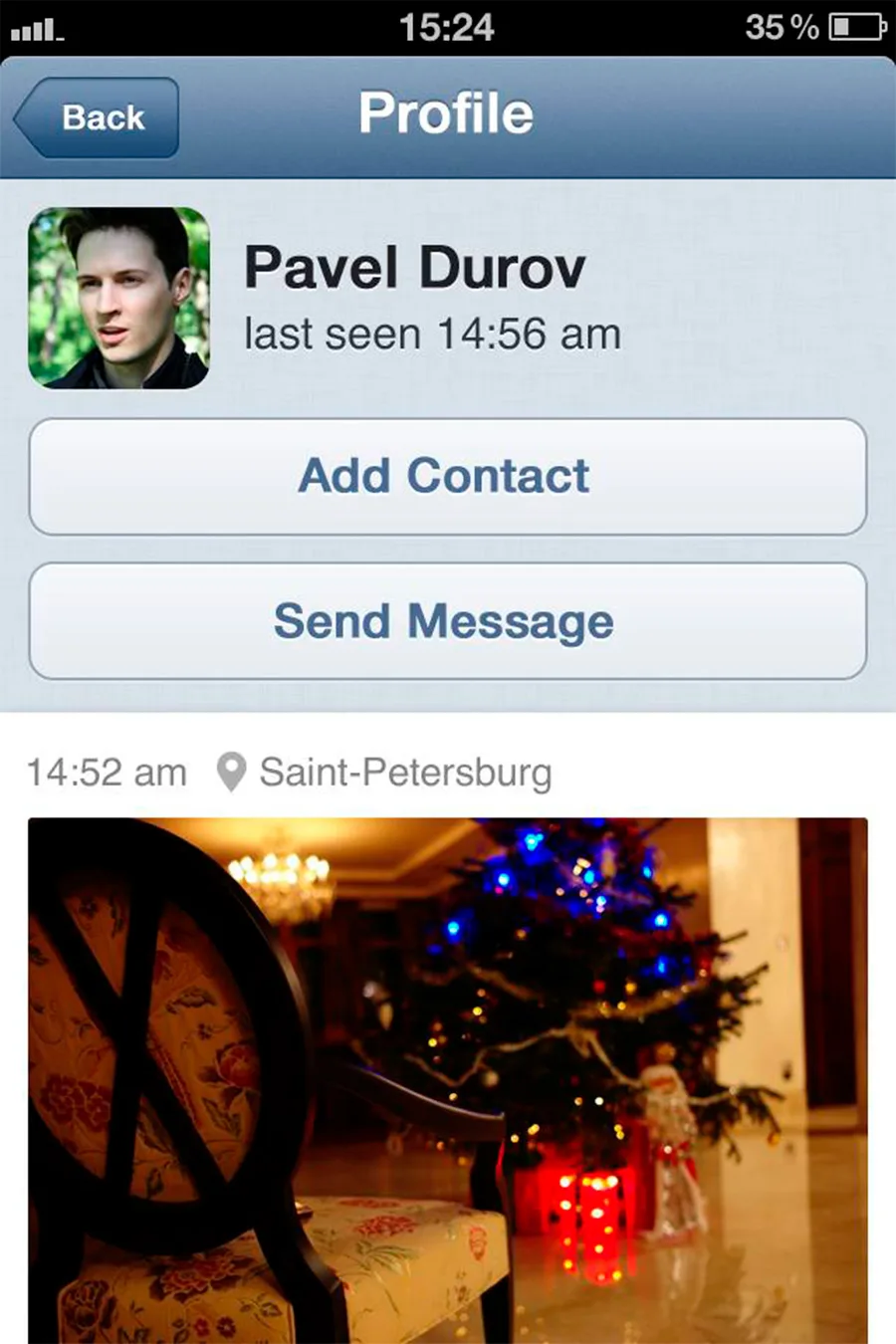
By the end of 2024, that started to change.

It turned out these tools could be pushed far beyond their intended purpose. Instead of accepting the limitations, users started treating them like building blocks.

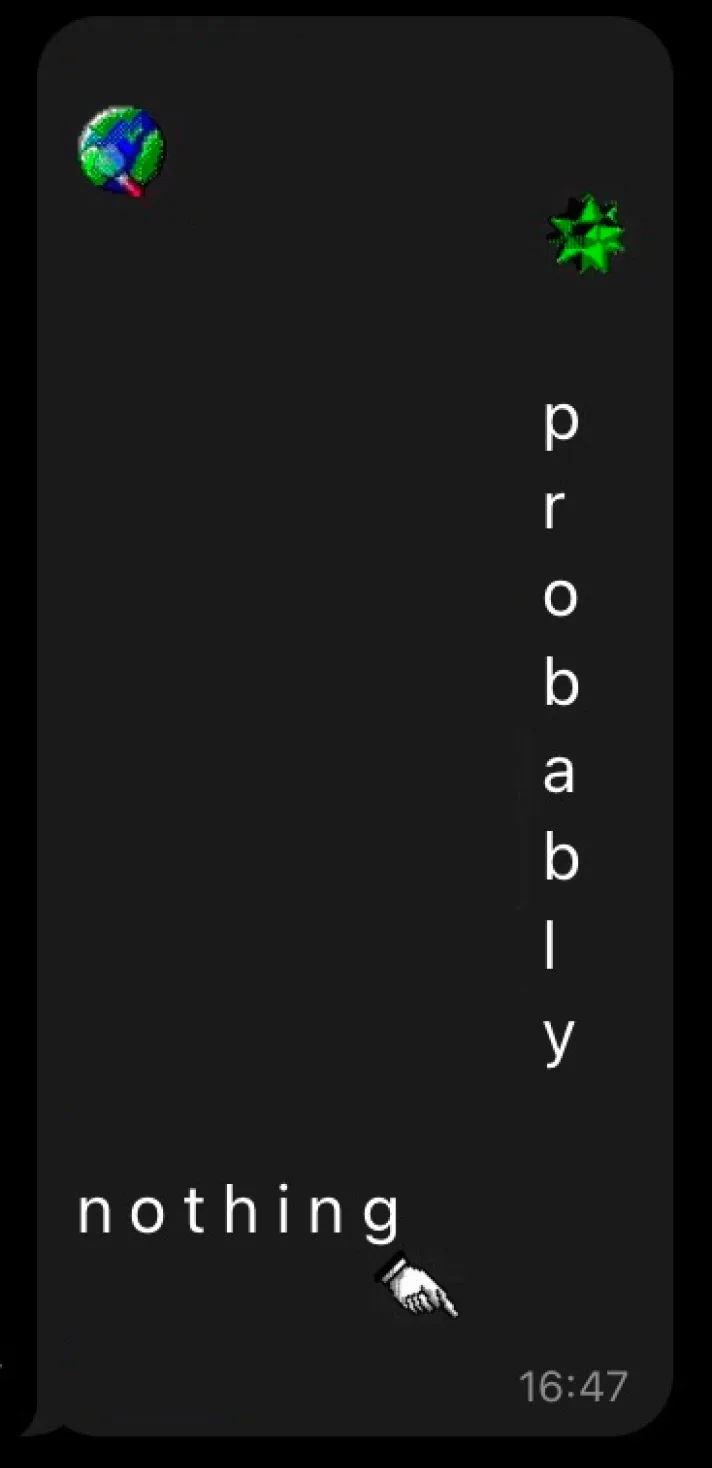
Emoji became pixels, letting people literally embed images inside a text post. Channels built entirely around emoji art began to appear, with each post becoming its own self-contained visual composition.

a self-contained visual composition.

These projects spread through group chats and quickly went from thousands to tens of thousands of subscribers.

Forbes would later describe it as "a new visual wave on Telegram," but at the time, few saw it as the beginning of anything important.

When it all began, Sasha srnk was doing something that seemed utterly pointless: trying to construct an image inside a post from hundreds of individual emoji.
You were one of the first people to make an emoji art post. How did that happen?

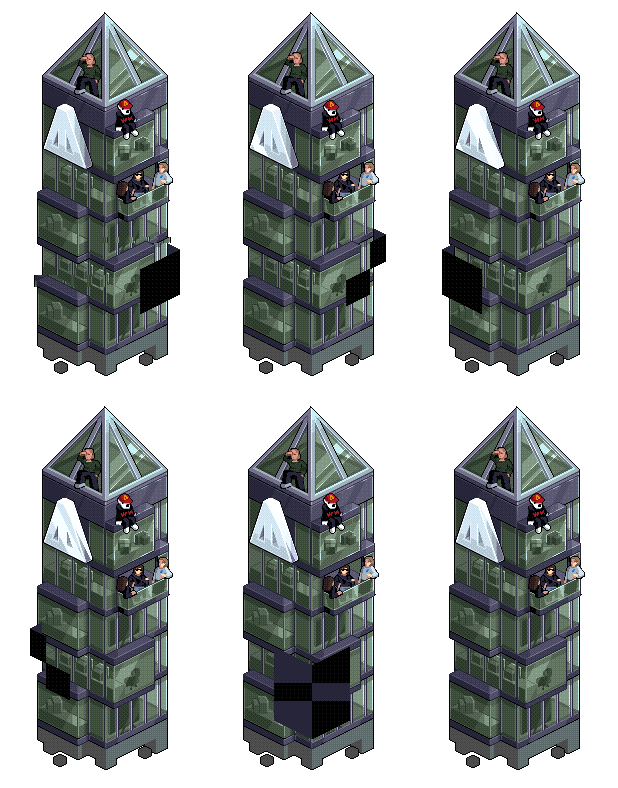
Honestly, there wasn't any grand idea behind it. It was more of an experiment. I wanted to see whether it was even possible to put together a mosaic inside Telegram, and how people would react.

I took my character Devboy and tried to recreate him entirely out of emojis.

The experiment worked: the post got shared more than 350 times, which back then meant people were REALLY blown away by what they were seeing.

ОБЩАЯ. 27.5K Просмотры, 12 Поделились публично, 370 Реакции, ~393 Непублично
What did the process of making posts like that actually look like?

Haha, I even remember putting together my very first one. I had some university stuff to deal with and was headed to another city by train. The trip took a couple of hours, and I spent the whole ride sitting there with my laptop, manually assembling an emoji canvas.

Before bots, every emoji canvas was sliced by hand

First, you cut the image into 100 little squares.

Then you convert those 100 squares into Telegram emojis.

After that, you manually upload every single emoji through the official bot.

Then you repeat that whole routine another three times until you get the result you want, and you're done!

Basically, one post could take hours. Now the same thing takes literally a few minutes, thanks to specialized tools.

Over time, all of that obviously became much easier. Was there a moment when you opened Telegram and realized it was becoming mainstream?

I don't think there was any one specific moment.

I just gradually started noticing more and more channels doing similar things. Around the same time, dedicated bots like DripTech started popping up, and a lot of things could already be automated.

That was what I loved most, because it felt like I'd somehow made my own small contribution to the whole thing.

What started as a creative way of styling posts eventually seemed to turn into an obsession with aesthetics.

Yeah, 100 percent.

With emoji-based design becoming a trend, every creator is trying to make their posts more and more unique.

As a result, posts become overloaded and start feeling more like images than text that's actually meant to be read.

How did those experiments affect your life?

I think there's a broader answer to that.

I think Telegram basically created a whole new service market for designers and social media marketers in Russia.

Creating custom emojis, designing stickers, and putting together posts with emoji canvases either existed on a much smaller scale or didn't exist at all.

Now every brand and company needs its own distinct way of communicating, which means more work for us.

So yeah, thanks, Durov! By the way, can I brag for a second?

Sure!

I wouldn't call it my greatest achievement or anything, but Pavel has used my emojis in two of his posts (1 and 2).

That really fires me up.

I'm basically one emoji handshake away from Durov.

CULTURE

It turned out that people cared not only about what they were reading, but also about how they were reading it.

Posts, Stories, channel design, advertising, and even the pauses between posts started merging into a single experience.

Posts, Stories, channel design, advertising, and even the pauses between posts started merging into a single experience.

That sounds grandiose, but it is hard to describe it any other way.

One of the clearest expressions of this approach was Bogdan Lebedev's OAO "Beautiful People".

By the time this article was published, more than 45,000 people were following OAO, and an entire ecosystem had grown around it, complete with connected projects, its own services, physical objects, events, and inside jokes.

Where did this whole story begin for you personally? How did OAO "Beautiful People" come to be?

It all started with a group chat for my birthday, where my friends and I dumped photos from a party at a country house. Then I started posting memes, then vibe photos, then vibe photos paired with the right track, then vibe photos all in the same color palette. After that I started experimenting with things like "Women's Day," "Red Day," "PlayStation Day," and so on.

Basically, themed content.

Once I had accumulated a huge pile of images from the internet, I started making sticker packs. Then I began making visual announcements for those sticker packs. After that I started assembling compilation emoji packs and searching the internet for anything that resonated visually.

Then our art director Anna (@yaebudesign) joined in and started teaching me not to be basic or outright cringe in my design. She made sure everything we put out visually was up to standard.

After that, I decided to build a community that would actually use all of it. I started pulling in friends of friends, taking small ad placements, and designing them to break through banner blindness on Telegram. I tried to make the ads unconventional. I built the community, set up chats, brought people together, and gave them things to do.

At the same time, I was developing the idea of a "spread."

"A spread is something that fits into one screenful, creates a feeling, and stays within a single theme. Like a magazine spread."

Then I started developing the concept of "the gut." That is when a spread is longer than a single screen. Two swipes long, for example.

After that, I started taking over the entire screen: the pinned post, profile picture, background, Stories, and the ring around the profile picture. I created this thing called "interactive Stories," where you add sound and buttons to an image, and people feel like they are pressing something and getting a response.

"All of this was fucking simple!"

At the same time, I was trying to develop the physical goods side of things, because objects are a language people understand very easily.

I kept developing the design studio and everything else so that nobody could put me into a single category. Every individual niche already has its top three players, and it is hard to squeeze in beside them. So I became something like Invoker. If you are good at many different things, it becomes harder to associate you with any one of them. You are not standing shoulder to shoulder with anyone. You stand apart, and people notice.

OAO stands for Open Joint-Stock Company. Because it was open, all sorts of fascinating characters gravitated toward it. And while people gravitated toward OAO, I gravitated toward people who were incredibly skilled. I became an apprentice to the greats and learned business from them.

Then I started applying the "zima blue" concept, taking over more and more of the screen and more and more of people's attention. Eventually it reached the point where I now give them ways to stay connected: a mobile carrier and a VPN, along with IRL events, design education programs, jobs at different companies, and internships. Plus stickers, emoji, a music bot, widgets, Telegram themes, wallpapers, online CS tournaments, and so on.

We do clothing giveaways all the time. It is like every user has digital pockets or an inventory, and I fill those spaces with items and useful things bearing my mark.

Every now and then, I try to fill people's heads with brighter thoughts too.

"The main rule of OAO is that, ideally, each move should ideally be harder than the one before it. That is the law of OAO's evolution. Adaptation and evolution."

"All of it is so my voice can sound inside their heads, the way it is sounding inside your head right now, reader. One, two, three, mic check. See? You can hear my voice inside your skull. I am in there."

Every now and then, I try to fill people's heads with brighter thoughts too.

I try not to let a trend or some fan demand dictate what I do. I want to decide for myself what OAO mutates into next.

"Everyone has money, but I am the only one who has my objects. I am the hand giving the object, not the hand asking for money."

I was just rapping. I was not thinking about it. It is simply life, my diary, a chronicle of what I was doing, who I was with, and at what moment. I trusted the process, made things for myself and my friends, and let other people get into it. I did not chase anyone away or look down on them.

A piece of clothing, a course, a digital product, an event, or a collab is just a variable that lets you demonstrate how loudly you can make noise online. And the need for a distinctive visual language is a fucking brilliantly executed solution to banner blindness.

"Normal brands run campaigns and marketing to sell the clothes. With me, the clothes, or whatever the phenomenon is, exist for the sake of the campaign and the marketing."

I used each product as a framework, creating a financial model that built marketing into the economics of the project and made the whole thing pay for itself.

How difficult is it today to make a Telegram channel that actually looks fresh, rather than like a blend of existing references?

"Doing DripTech, stickers, emoji, image wankery, 3D CGI AI shit right now is already bad taste. I recommend going back to photos and video and stopping fucking around. That card has been played. Goodbye."

Nobody needs channels polished within an inch of their lives. In an overcrowded world where everyone endlessly quotes everyone else's work, people need something that gives them a new emotion or feeling. And you clearly do not get there by browsing Instagram, Pinterest, or Telegram for references and trying to imitate somebody.

You need to create your own games. Your own meta. If you think within the rules of someone else's game, all you will produce is another variation of something people have already seen.

How do you explain your own journey from underground Telegram aesthetics to Forbes 30 Under 30?

"Nihilism, bitches, money, power, drive, leadership, boiling blood, and the refusal to spend a single day in the same position, state, condition, or status as the day before. The refusal to be a button or a function. A hunger to study, create, make realities resonate, pull strings, and impose my own."

If you follow a plan made up of small elements, you can build something enormous. It is like LEGO: the structures can be huge, but the pieces are always small.

At some point, people dug iron out of the ground and, by following a plan through a sequence of elaborate manipulations, turned it into interplanetary spacecraft.

"So the journey from a group chat full of country-house photos to a magazine headline is nothing. The only thing easier is becoming a famous rapper."

What do you think will be the next stage of this whole "new visual wave" inside Telegram?

I think we are heading into stagnation or a plateau for the next two or three years, at least until new capabilities appear within the Telegram ecosystem.

After that, maybe we will be able to go even deeper. Though I doubt it. The platform would need more customization tools and more ways to work with communities.

Telegram is basically an open-source system. We use all kinds of hacks and workarounds inside it to make different things. Some of it is limited by imagination, and some by technical capabilities.

"If no fucking incredible updates happen at all, the visual wankfest will settle down, cool off a little, and survive in a weakened form across certain publications, brands, and so on. It is like a linguistic system: once it is there, it stays. You cannot erase it anymore."

Where it goes from there is more complicated.

I think that in half the cases, the people doing this simply do not understand the actual substance of what is happening. They want something similar for their channel, so they commission it from someone who is only there to execute and, deep down, does not give a fuck. That person is not going beyond the brief or the task they were given.

In the other cases, it is some young guy simply copying what he saw.

The problem is that nobody has yet properly figured out how to immerse a person more deeply in the visual and contextual reality being created.

The problem is that nobody has yet properly figured out how to immerse a person more deeply in the visual and contextual reality being created.

Over time, many major brands become hostages to their own audience and start giving people exactly what they expect. You seem to do the opposite, constantly trying to escape everyone's expectations. Was there ever a moment when you had to deliberately disappoint people so you would not lose your own interest in the game?

Although, honestly, I think I disappoint someone on a regular basis.

I might be slow with shipping. I might accidentally sell T-shirts with a print that later starts crumbling off. I might say I will do something tomorrow and then not do it.

"Well, what the fuck... I am doing the best I can. Right now, this is what my best looks like. Anyone who does not like it should jump ship."

Overall, I take a pretty simple view of it. Any purchase from me, or any way of taking part in what I do, is a donation. It is a vote with your wallet for the chance to see what happens next.

At the same time, it is a chance to own an object from a specific period in OAO's existence. I have never tried to disappoint people deliberately for some kind of effect.

"I am happy to impress people. But sometimes I drop a dud. It happens."

INDUSTRY

The aesthetic started spreading into other channels, attracting imitators and gradually escaping its own bubble.

Perhaps no project illustrates that transition better than .solutions.

It is difficult to describe it in conventional terms. Technically, it is a clothing brand. In practice, the clothes have always been just one part of a much larger structure.

Gleb Kostin has always built an entire cultural context around it. Clothes, objects, visual experiments, inside jokes, characters, collaborations, and digital artifacts all existed within the same frame of reference and constantly pointed back to one another.

For the same reason, Telegram quickly stopped being just a place where .solutions posted announcements.

Posts began serving the same purpose the clothes once had. They told stories, set a mood, created a sense of belonging to a particular scene, and made the brand recognizable without a logo.

Much of that work was handled by sasha svoloch, who joined .solutions at the exact moment Telegram was beginning to evolve from a communication channel into a creative discipline in its own right.

How did you meet Gleb? When did you become part of Solutions?

It was autumn 2024, and Solutions was holding a model shoot. The photographer @geneva invited me to take part as a model. They shot some photos of me and tagged me on Instagram. By coincidence, I had just published a post saying I was open to collaborations.

A couple of weeks go by, and a comment from .solutions appears:

"Hey, message us."

So I did. We started talking, and I told them what I could do.

The first things we made together were exactly those emoji experiments of mine.

I made these tiny emoji compositions. Then I started designing the drops. And essentially, what I started doing back then is still what I spend most of my time doing now.

How did you get into emoji art in the first place?

How did you get into emoji art in the first place?

I first started noticing it sometime around the middle of autumn 2024.

At first, they were just small experiments.

There was pixel emoji art in .solutions, for example, where three to six tiny emojis would form a single image. Then came the .solutions promo codes.

Gradually, this stuff started showing up everywhere. I wanted to try it because it offered a new way to move beyond ordinary posts. By then, people had already learned how to make video messages, lay out images, and assemble different things inside Telegram. I wanted to find something new.

I remember making my first animations entirely by hand. I rendered every emoji separately, then manually sliced everything into 100x100-pixel pieces. One image was made up of eighty emojis, which meant preparing eighty separate files, running each one through an encoder, and uploading them one by one through Sticker Bot. I think I only got it right on the third attempt.

"I remember it being a complete fucking nightmare. The first time I did it, I sat there for three or four hours."

Then DripTech appeared. I started using it heavily and talking to Alim. At the time, there was still no proper way to upload transparent PNGs, so everything had to be done with chroma keying and various workarounds. Once it became possible to upload files normally, it completely opened things up.

I have been using it constantly ever since, waiting for Telegram to come up with something new.

How does content for Solutions actually come together?

With every project, we try to make the process more systematic, so nothing is a shot in the dark and everything follows a clear logic.

Usually, a drop is coming up. A message from Gleb appears in the work chat. There is a new task.

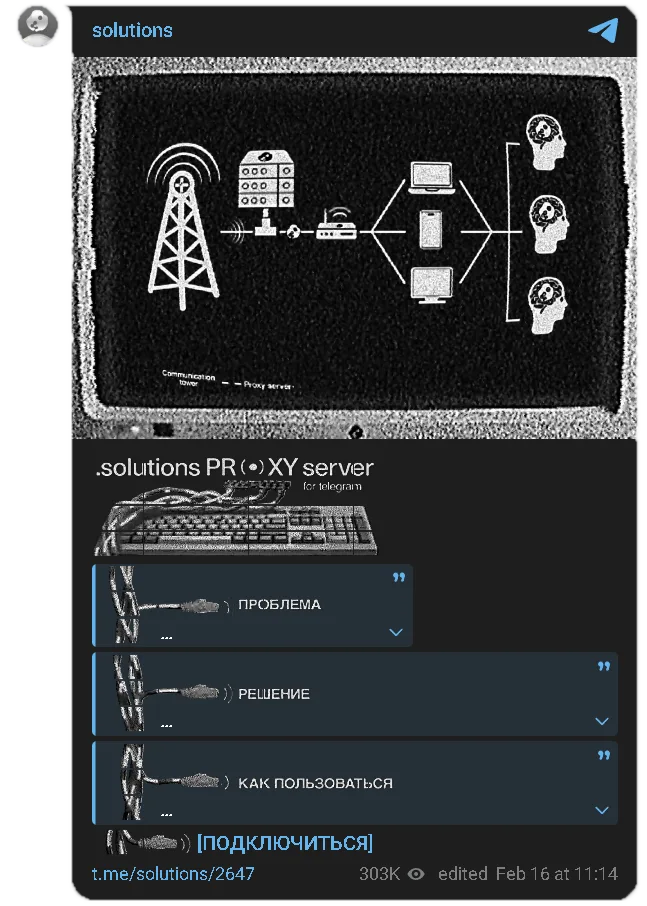
Say we need to find a way to highlight the SIM cards and play with the idea. Sometimes the overall direction is set immediately. A story about microchipping, for example.

At the same time, it is obvious that the post needs to contain a lot of information. You cannot communicate an idea like that through pretty pictures alone.

First, we sketch everything out. We plan the transitions. What will be an image? What will be a video message? What will be text?

Then we put together several options, present them, choose the best ones, refine them, and start producing the final version.

Sometimes an idea looks good at the sketching stage, but later you realize that everything needs to be reinvented from scratch.

The approach itself always stays the same.
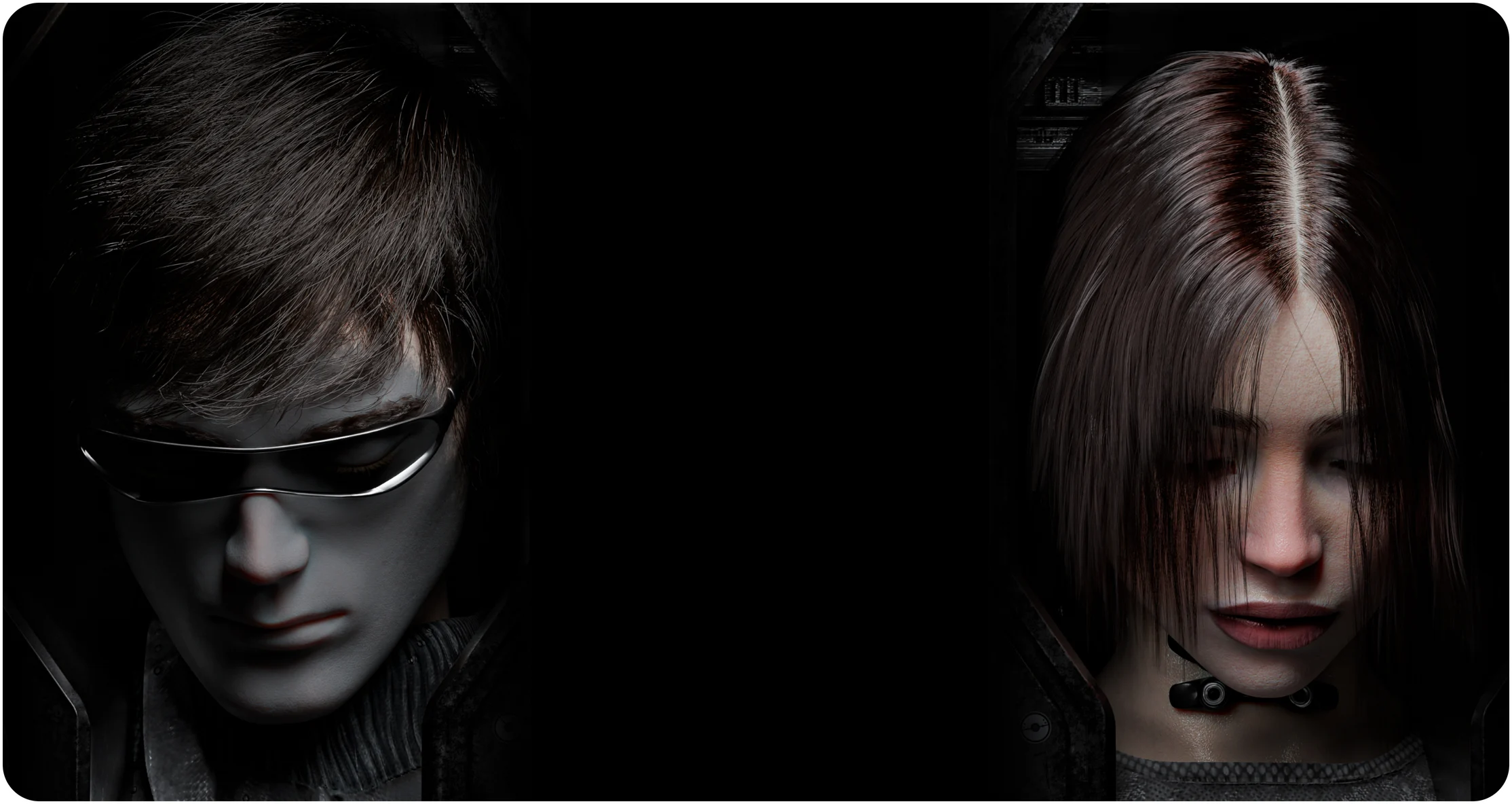
"It should not only look good. It should be informative too."

Because when you are speaking to an audience of tens of thousands, people need to understand exactly what you are showing them. Meaning always comes first.

Legend has it that Sasha Svoloch sketches his posts on a whiteboard first. Is that true?

Yes, it is.

Either a whiteboard, or paper and a pen.

If you open Blender or Telegram straight away and try to build everything there, it is incredibly easy to get lost.

It is literally a previsualization stage. First you need to sketch it, understand what goes where, and only then start assembling, generating, and laying everything out.

You genuinely cannot do without it.
Would you say Telegram has already become part of the Solutions brand identity?

I think so.

The thing about Solutions is that the drops can be completely different. One has one kind of lore, another has something else. One is entirely black and white, another is green, another is blue.

From the outside, it can look chaotic, yet it still feels like the same channel. That is because there are brand guidelines, a set of fonts, rules for presenting information, and a list of things that must remain consistent regardless of the particular drop.

"All of it comes together to create the feeling of a single brand."

Why has Telegram proven so well suited to visual experimentation?

On Instagram, you scroll through an endless feed. Something appears in front of you, and you immediately keep moving, unless you are a die-hard fan of a particular brand or person.

Telegram is different.

"Say I follow SRNK. I see a new post and tap it. It feels like I have opened a door and stepped inside. I have already chosen to look at it."

That means you can make more complex things here. People are prepared to pay attention. They come here to learn something.

"That is a huge difference."

What is the most complex emoji art you have made?

That means you can make more complex things here. People are prepared to pay attention. They come here to learn something.

"That is a huge difference."

The main question is no longer how to assemble the emoji, but how to make the medium itself unique. Because back then, any picture built out of emoji already looked like magic.

Now it's usually the other way around. Clients come to us and say:

We already know how to do it like everyone else. We need it to be genuinely fucking good.

What do you usually use in your work?

What do you usually use in your work?

To make a great post, I need a pencil, several sheets of paper, Blender, Figma, Photoshop, After Effects, DaVinci Resolve, and sometimes AI tools.

That is my main stack.

What is Telegram still missing today?

If I could ask Telegram for anything...

More emojis in a single message.

Longer animations.

Proper synchronization, because sometimes one canvas loads and the second one does not, and the entire composition falls apart.

But most importantly, hyperlinks inside custom emojis.

Right now, making a button requires a whole mess of workarounds: emojis, text, brackets, and various other hacks.

If a custom emoji could function as a link, that would be insane.
INFRASTRUCTURE

Every person featured in this article mentioned DripTech in one way or another, and it is easy to see why.

If the Telegram aesthetic ever developed an infrastructure of its own, DripTech was largely responsible for it. The bot made it possible to turn images into emoji art in a matter of minutes, saving people hours of manual work.

Beyond its practical purpose, DripTech built an entire universe around itself. Its internal currency is called "chips," the referral program invites users to "spread the virus," and the support button is hidden under the word "consolation."

Endless aura.

How much Telegram content passes through DripTech today, in your estimation?

6,040,911 emojis, not counting posts and stickers.

What was the hardest part of building the tool?

the hardest part isn't building it technically. the hardest part is not puking from how badly everything in Telegram begs for violence, while almost nothing in it is built for that.

Which project made with DripTech gave you that "this is it" feeling?

one of the first driptech "user cases" was @sashasvoloch. i think his work in the very beginning gave us that reaction

overall, us and @solutions created the perfect tandem because they know how to experiment with presentation
It feels like DripTech both helped create a new Telegram aesthetic and brought it closer to death. Once the tool became available to everyone, its uniqueness started fading. Have you thought about that?

every action brings us closer to death. whether you move forward or backward doesn't matter.

if we hadn't made it, somebody else would've sooner or later.

you could say the same about the creation of the DAW, that it killed "classical music", but we think everything has its time.

there was a filter and a pose.
What would your life look like today if Telegram had never introduced custom emojis?“
“
What would you ask Durov to add in future updates?

batch uploading/adding stickers. a meaner API. native 3D.

more freedom for packs, storefronts, reactions, private mechanics, internal economies.

Pasha, we'll take it from here.

What is behind the way you communicate on the channel?“
“

Interestingly, right in the middle of our conversation with the DripTech team, Telegram released one of its most unusual updates in years.

Telegram News

Rich Text Editor. You can now create articles and long posts in a visual editor that supports dozens of formatting options and allows you to generate text with privacy-conscious AI tools.

July Features
1234More

t.me/telegram/450

Thirteen years after the messenger launched, it finally introduced full post formatting.

Images, video, and audio can now be embedded directly into the body of a message without any third-party tools.

That raises an interesting question.

DripTech essentially allowed users to turn images into emoji compositions and embed them directly into the structure of a post, giving Telegram a feature the platform itself never originally had.

Now some of those capabilities are becoming native. So the main question is not even what happens to DripTech, but what happens to the entire aesthetic that grew out of the platform's limitations.

By 2026, Telegram's visual culture had grown into a design market with its own tools, studios, and contractors.

Large companies were trying to understand why some channels felt alive while others looked like soulless feeds of press releases.

Gradually, asking for a Telegram channel «like Beautiful People» stopped sounding unusual. Clients wanted video messages, emoji-built posts, and the feeling that there were real people behind the channel, not a brand.

One of the most visible figures in this space was Nijat Huseynov, the creator of Colleagtion.

He made collectible toys inspired by office life, worked with emoji art, and launched projects for IT corporations and grocery retailers.

Telegram is tumblr now.

this will only be good for DripTech.

complex systems = more bugs.

BUSINESS

First impressions of the update?

If you work with corporations or collaborate with major brands, how do you usually explain the value of emoji canvases to them?

Honestly, we usually don't have to explain anything. In 99% of cases, brands come to us themselves after seeing one of our posts or images.

When it comes to corporations, they are watching. And somehow, the core of our audience today isn't white-collar workers, but the creative crowd inside large companies.

SMM managers, creatives, marketers, and other people who work inside corporations and are constantly looking for new formats. They saw us doing something unusual with fairly ordinary office themes and started following us.

So this is already a primed audience. When they see another post made from composite emojis, they don't come to it cold. They see it through the lens of everything we've done before. That makes the surprise hit even harder.

The conversation usually starts very simply:

"Damn, Nijat, hey. How much would a post cost? What are the terms for a collab?"

Recently, I even saw an interesting phrase in a commercial proposal. They described it as a separate genre:

"Posts with composite emojis and lists."

"Haha, that sounds extremely corporate."

Yeah, yeah.

Usually, we just show examples of what it could look like. Then the client says yes or no. But honestly, we almost never sell composite emojis as a standalone thing.

When someone comes to us saying:

"We want to make something, but we have no idea what."

We're more likely to propose a full interactive day built around a specific occasion or date. And one of its elements might be some elaborate-as-fuck post assembled from an image flowing into emojis, emojis flowing into stickers, and so on.

We did something like that with Perekrestok. We went fucking nuts with stickers, emojis, and everything else. Judging by the reactions, it worked insanely well, especially considering it was an ad.

Even so, we still don't position emoji-driven concepts as a separate product.

"We are extremely meticulous about composite posts. They are difficult."

On the other hand, we're constantly watching what other people in the market are doing, and we get inspired ourselves. We sit there thinking:

"Damn, we need to use this too."

When you consider yourself a creative person, you naturally want to use tools like this and translate them into a format that an ordinary user can understand.

Essentially, Telegram's capabilities created an entirely separate market for creators and companies like yours. Before, you could sell a post, a Story, and maybe something else. Now you can sell composite posts, emoji mechanics, and other similar things as separate products.

Yes. And it's also a competitive advantage.

When you make these intricately constructed posts, it automatically boosts your creative aura. People open the channel and see that somebody built an entire system for a post that could have been just text or a single image.

Take Solutions.

Sasha and his team have pushed it almost to its absolute limit. Every information-heavy post turns into a puzzle you have to unpack just to understand how it works.

It works on two levels. On one hand, the post is informational. On the other, it's creative. And you sit there losing your mind:

"Fuck, why didn't we think of that?"

Don't you think posts like that can become too difficult to process? That something which works for Solutions fans and people who enjoy this kind of content might be confusing to the audience of an ordinary company?

I agree that if this kind of content appears without context, part of the audience may genuinely scroll past it.

"Why does this look so fucking good?"

Don't you think posts like that can become too difficult to process? That something which works for Solutions fans and people who enjoy this kind of content might be confusing to the audience of an ordinary company?

I agree that if this kind of content appears without context, part of the audience may genuinely scroll past it.

But a lot depends on the audience itself.

Because there might be something fun inside.

"And that expectation of something fun plays a huge role."

You need to create the sense that any post might surprise you somehow. Maybe you can win something. Maybe there's a giveaway. Maybe there's an inside joke hidden in there that only people who read to the end will understand.
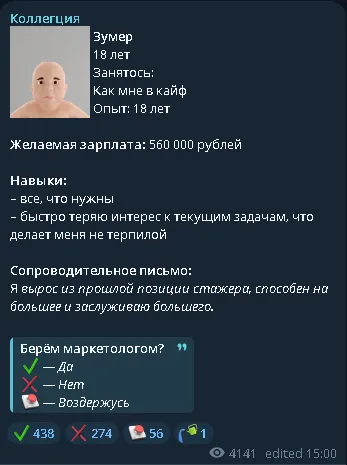
It's more or less the same with reactions. We still haven't disabled them because we see them as part of our interaction with the audience. Feedback matters to us.

"The more feedback we get, the better we understand what we're doing well and what we're doing badly."
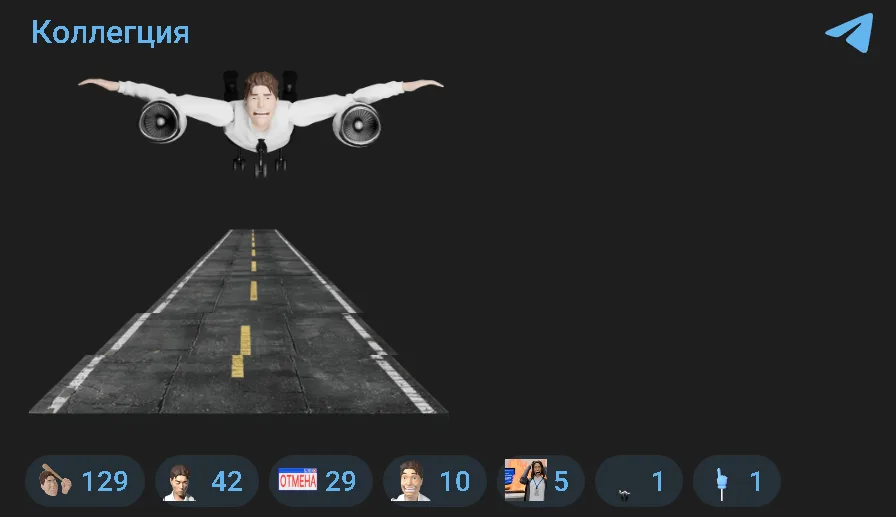
"The more feedback we get, the better we understand what we're doing well and what we're doing badly."

Do large companies usually manage to enter formats like this at the right time, or do they tend to show up once the trend has almost burned out?
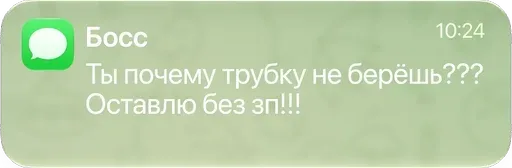
There's an important point here. If some brand guy is reading this, the point isn't whether you enter a trend early or late. The point is to come up with something of your own on top of it.

Usually, brands just take a trend and add nothing to it. That's why it comes out cringe.

a trend and add nothing to it. That's why it comes out cringe.

Say a trend appears. The next day, a branded version of that trend comes out. Then another one. Then another. And the whole thing looks like a copy of a copy of a copy. Some trends move so fast that everyone is already fucking sick of them an hour later. Others have a little more staying power and last for a few days or a week. But brands shouldn't simply repeat them. They need to think about how to present them in a different format.

Sasha from Solutions and I talked about this a lot. He told me that before assembling a post, he draws it on a board, moves the elements around, and checks how everything works. I think brands should treat these things as research too.

Sasha from Solutions and I talked about this a lot. He told me that before assembling a post, he draws it on a board, moves the elements around, and checks how everything works. I think brands should treat these things as research too.

"Damn, some trend is working. Let's take it and post it."

That will be cringe.

Even we sometimes use memes that died a long time ago.

Even we sometimes use memes that died a long time ago.

"They haven't just been buried. They've already rotted."

But we rebuild them inside our own setting and add new jokes on top that work now. That takes time too. You need to come up with the idea, understand how to present it, and figure out what new thing it adds.

The problem starts when someone takes a finished mechanic and simply changes the text.

For example, we made an envelope with a message that opened up. Then somebody saw it and went: "Oh, cool format." They took the exact same envelope, changed the words, and posted it.

We look at that and think:

"Damn, at least come up with something of your own on top of it."

The same thing happened with stamps, signatures, and other mechanics. But the point was never the mechanic itself.

"If there is a trend, you need to sit down and think about how to improve it."

You need to create the sense that any post might surprise you somehow. Maybe you can win something. Maybe there's a giveaway. Maybe there's an inside joke hidden in there that only people who read to the end will understand.

"The more feedback we get, the better we understand what we're doing well and what we're doing badly."

If a regular SMM specialist inside a company wants to pitch an emoji-based special project to management, what should they emphasize? Reach? The trend? Brand image?
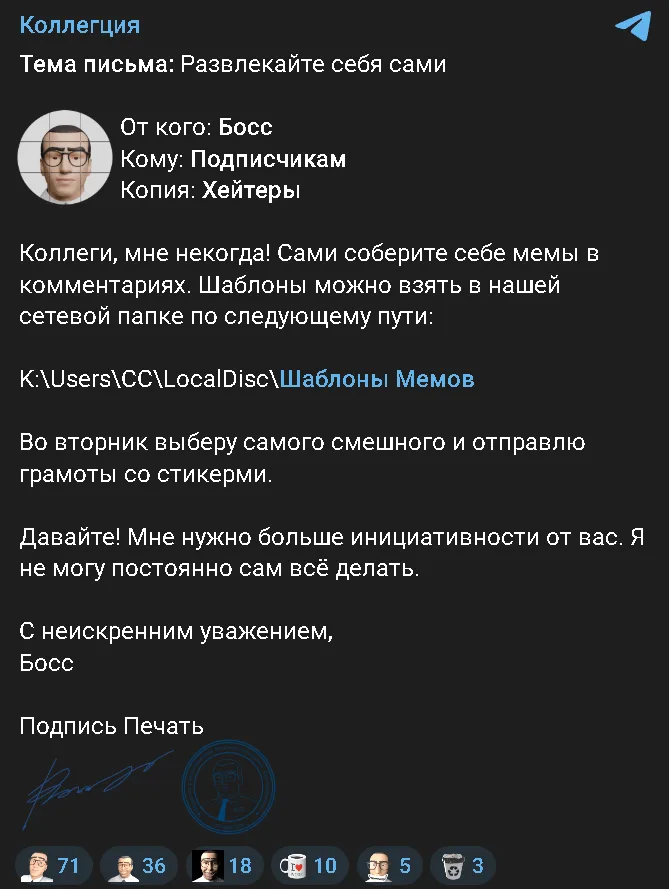
Damn, honestly, we don't really do that.

When people want to make something with us, we say:

"Come over. Let's make it."

The whole thing with slides about reach, views, and evidence for why the project needs to happen is very rare for us. I think it happened only once.

Colleagtion was running out of money, so we decided to put together a commercial proposal and go back to old clients. Just to cover some expenses and pay the team.

But it turned out funny. The very first client we contacted agreed immediately, simply because they were interested in trying something unusual.

Other than that, when people come to us now, I usually say:

"What reach? We don't sell reach. If you like what we do, then let's make something."

It's more of a brand-building project. Guaranteeing numbers on algorithm-driven social platforms is extremely difficult now anyway. On Telegram, you can look at a channel's average views and get a rough sense of the scale, but we don't like sitting there trying to persuade people.

We're more interested in working with people who already know us, have seen our work, and understand the context. Now it's usually the other way around. Clients come to us and say:

«Now it's usually the other way around. Clients come to us and say:

"Handle the creative yourselves. Handle the presentation too. Build the entire framework."

We answer:

So in practice, we handle the whole thing end to end. Most clients like that approach. When it comes specifically to emojis, we simply show the options on calls and explain:

So in practice, we handle the whole thing end to end. Most clients like that approach.

This article was supposed to be about emoji art, but in the end it became an article about people.

About creative people who managed to turn nothing into a language, tools, communities, and an entire market worth hundreds of thousands of dollars, a market that simply didn't exist a few years ago, and couldn't have existed.

What happens next?

Now that Telegram itself has opened up to this culture, predicting anything has become even harder.

This is probably a good place to stop and let the process happen.